 Lesser Black-backed Gull (graellsii & intermedius)
(last update:
lbbg 1cy May
lbbg 1cy June
lbbg 1cy July
lbbg 1cy August
lbbg 1cy September
lbbg 1cy October
lbbg 1cy November
lbbg 1cy December
lbbg 2cy January
lbbg 2cy February
lbbg 2cy Mar-April
lbbg 2cy May
lbbg 2cy June
lbbg 2cy July
lbbg 2cy August
lbbg 2cy September
lbbg 2cy October
lbbg 2cy Nov - Dec
lbbg 3cy Jan-April
lbbg 3cy May
lbbg 3cy June
lbbg 3cy July
lbbg 3cy August
lbbg 3cy September
lbbg 3cy October
lbbg 3cy Nov - Dec
lbbg sub-ad Jan-April
lbbg sub-ad May
lbbg sub-ad June
lbbg sub-ad July
lbbg sub-ad Aug
lbbg sub-ad Sept
lbbg sub-ad Oct
lbbg sub-ad Nov
lbbg sub-ad Dec
lbbg adult January
lbbg adult February
lbbg adult March
lbbg adult April
lbbg adult May
lbbg adult June
lbbg adult July
lbbg adult August
lbbg adult September
lbbg adult October
lbbg adult Nov - Dec
third calendar year: November - December
The birds shown here are in third winter plumage (3cy). LBBG in 3cy and 4cy can look very much the same in early winter, and particularly when the outer primaries are lost, it may be hard to age many of these sub-adults correctly. Those in 4cy are often recognized by and distinguished from 3cy by the grey outer primary coverts (though with black centres in most cases, as seen in full-adult LBBG as well) and the extensive white tips to the outer primaries and larger mirror on p10 (though this may be sex related and geographical variation . Also, in most cases, the black markings on the bill are less developed in 4cy birds; 4cy LBBG are more adult-like in bare part coloration.
Some photographed sub-adults with rings show the difficulty and variation of sub-adult in the period where the outer primaries are not indicative. See the adult and sub-adult sections.
3cy LBBG normally show some/all of these features:
- Very pale legs and much black on the bill, combined with a pinkish base, which are more adult-like in 4cy (image 1);
- The old coverts are extensively brown bleached and on average adult-grey in 4cy;
- New tertials show a grey base with a white tip which is confined to the inner-web (image 2). Old tertials are either brownish bleached or show a dark brown-black centre and vermiculation on the upper half. In 4cy, the old abraded tertials are all plain normally;
- Scapular coverts may be rather brownish centred, not pure grey as in 4cy and adults (image 3);
- Some of the recently moulted tail-feathers show black isolated spots near the centre (often found in the inner tail-feathers: image 2);
- Primaries show very small white tips in 3cy, especially the outer primaries p6-p10 (image 3). In 4cy these primary tips normally are larger, but this may vary with populations;
- The mirror on p10 is relatively small in size and a mirror on p9 is lacking. 2cy normally don't show a mirror at all and 4cy have the mirror on p10 well-developed. The 3cy p10 mirror is an isolated white spot and normally doesn't reach the feather edge (image 1).
- Primary moult score is high on average (image 1), compared to the more adult-like primary moult score of 4cy. In this respect, 3cy moult strategy is closer to that of 2cy and 4cy is closer to adults. By November, many 3cy have primary moult score of 50, hence all the primaries renewed and fully grown.
Tables
| Primary moult score of 3cy LBBG, at Naaktstrand, Maasvlakte, the Netherlands (51.59N, 04.02E) on November 06 2001. | ||||||
.PMS: |
P7 fg | P8 fg | P9 fg | P10 fg | n: | m: |
n: |
0 | 2* | 29** | 79*** | 110 | 9,7 |
| n: sample size, m: average score for mixed flock graellsii, intermedius . * both birds with old P10 present (incl intermedius JSM7 blue). ** incl graellsii BLAJ blue. *** incl graellsii EU31 orange. |
||||||
LBBG 3cy U.K.: graellsii
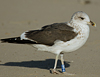 Lesser Black-backed Gull graellsii F:046 3CY-4CY, December 2016 - January 2017, Matosinhos beach, Matosinhos, Portugal. Picture: José Marques.
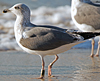 Lesser Black-backed Gull graellsii 4R4:C 3CY, November 15 2016, Torreira beach, Aveiro, Matosinhos, Portugal. Picture: José Marques.
 Lesser Black-backed Gull graellsii 2CT8 3CY-4CY, December 2015 & September 2016, Matosinhos, Portugal. Picture: José Marques.
 Lesser Black-backed Gull graellsii L+R 3CY, November 09 2016, São Felix da Marinha, V.N.Gaia, Portugal. Picture: José Marques.
 LBBG CCE December 20 2009, Madrid, Spain. Picture: Delfín González. Also seen as January 3cy.
LBBG 3cy from France: graellsii "Dutch intergrade"
.
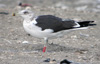 LBBG 422N December 14 2008, Madrid, Spain. Picture: Delfín González.
LBBG 3cy from Belgium: graellsii "Dutch intergrade"
.
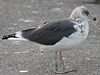 Lesser Black-backed Gull graellsii RKA.V 3CY, November 18 2016, Portimao Fish harbour, Portugal. Picture: Carl Baggott.
LBBG 3cy from the Netherlands: graellsii "Dutch intergrade"
.
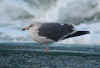 LBBG E546E November 27 2003, Westkapelle, the Netherlands.
Picture Pim Wolf.
LBBG E546E November 27 2003, Westkapelle, the Netherlands.
Picture Pim Wolf.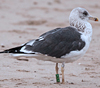 Lesser Black-backed Gull graellsii K.AZX 2CY-5CY, August 2014, December 2015 & October 2016 - January 2017, the Netherlands & Portugal. Picture: Maarten van Kleinwee & José Marques.
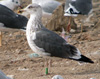 LBBG KNAP November 01 2009, Madrid, Spain. Picture: Delfín González.
LBBG 3cy from N Germany: graellsii - intermedius
.
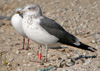 LBBG H167 November 28 2010, Madrid, Spain. Picture: Delfín González.
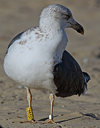 Lesser Black-backed Gull graellsii HV447 3CY, December 05 2016, Matosinhos beach, Matosinhos, Portugal. Picture: José Marques.
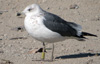 LBBG H780 November 28 2010, Madrid, Spain. Picture: Delfín González.
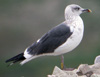 LBBG H31C December 31 2008, Madrid, Spain. Picture: Delfín González.
LBBG 3cy from Denmark: intermedius
.
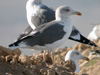 LBBG V623 November 28 2010, Madrid, Spain. Picture: Delfín González.
unringed LBBG 3cy
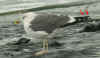 LBBG 3cy November 08 2001, Westkapelle, the Netherlands.
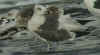 LBBG 3cy November 08 2001, Westkapelle, the Netherlands.
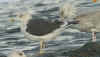 LBBG 3cy November 08 2001, Westkapelle, the Netherlands.
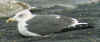 LBBG 3cy November 08 2001, Westkapelle, the Netherlands.
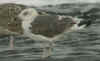 LBBG 3cy November 08 2001, Westkapelle, the Netherlands. Same bird
as in image 2.
LBBG 3cy November 08 2001, Westkapelle, the Netherlands. Same bird
as in image 2.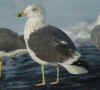 LBBG 3cy November 02 2002,
Westkapelle, the Netherlands. P10 still present.
LBBG 3cy November 02 2002,
Westkapelle, the Netherlands. P10 still present.