 Lesser Black-backed Gull (graellsii & intermedius)
(last update: June 25, 2012)
lbbg 1cy May
lbbg 1cy June
lbbg 1cy July
lbbg 1cy August
lbbg 1cy September
lbbg 1cy October
lbbg 1cy November
lbbg 1cy December
lbbg 2cy January
lbbg 2cy February
lbbg 2cy Mar-April
lbbg 2cy May
lbbg 2cy June
lbbg 2cy July
lbbg 2cy August
lbbg 2cy September
lbbg 2cy October
lbbg 2cy Nov - Dec
lbbg 3cy Jan-April
lbbg 3cy May
lbbg 3cy June
lbbg 3cy July
lbbg 3cy August
lbbg 3cy September
lbbg 3cy October
lbbg 3cy Nov - Dec
lbbg sub-ad Jan-April
lbbg sub-ad May
lbbg sub-ad June
lbbg sub-ad July
lbbg sub-ad Aug
lbbg sub-ad Sept
lbbg sub-ad Oct
lbbg sub-ad Nov
lbbg sub-ad Dec
lbbg adult January
lbbg adult February
lbbg adult March
lbbg adult April
lbbg adult May
lbbg adult June
lbbg adult July
lbbg adult August
lbbg adult September
lbbg adult October
lbbg adult Nov - Dec
sub-adult: July
In moult pace and moult strategy, sub-adults (4 / 5 cy) strongly resemble adults. Since many sub-adults are pretty hard to separate from adults, it's difficult to be certain about the average plumage in July, because advanced individuals may be aged wrong and subsequently missing in surveys (or are at least underestimated). This seems particularly the case in fast moulting intermedius LBBG, where even full-adults may show very small mirrors on p10 and p9 and the tips of the outer primaries appear relatively small. This makes correct ageing very difficult.
Nevertheless, we feel some characteristics, particularly accumulated in a single individual may point to sub-adultness:
- very small white tips on the old outer primaries (beware wear),
- a very limited white mirror on the old p10 and absence of a mirror on p9,
- isolated black markings on old, worn rectrices,
- brown centred coverts, often found in the carpal edge (outer lesser coverts),
- vermiculation on (central) tertials or an accentuated black centre in the tertials, which may have the white tips confined to the inner web,
- immature colouration of bare parts,
- secondaries show brownish centres with a zigzag pattern along the trailing edge.
Used as a single characteristic, the evidence is not very convincing, but individuals that combine these characteristics are probably 4cy or 5cy LBBG. For exctensive research of birds in the hand, see SUB-AD MAY SECTION.
 |
 |
 LBBG 4cy BTO E15895 July 18 2012, Calais, NW France. Picture: Jean-Michel Sauvage.
 LBBG 5cy RXB August 01 2009, Calais, NW France. Picture: Jean-Michel Sauvage.
 LBBG 4cy-6cy 600N 2010-2012, Calais, NW France. Picture: Jean-Michel Sauvage.
 LBBG 5cy FRP EA676223 / 826N July 17 2012, Calais, NW France. Picture: Jean-Michel Sauvage.
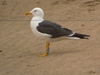 LBBG 5cy GRAR July 03 2010, Heemskerk, the Netherlands. Female, also as 7cy.
 LBBG 5cy HKAB April & July 2012, Calais, NW France. Picture: Jean-Michel Sauvage.
 LBBG 4cy-5cy NHAH July 2013 & April 2014, Calais, NW France. Picture: Jean-Michel Sauvage.
 Lesser Black-backed Gull graellsii UV.AM 4CY, July 08 2015, Rotterdam, the Netherlands. Picture: Merijn Loeve.
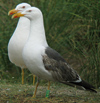 LBBG 4cy KNAR July 25 2010, Kelderhuispolder - Texel, the Netherlands. Picture: Maarten van Kleinwee.
 LBBG 4cy KLAX July 25 2010, Kelderhuispolder - Texel, the Netherlands. Picture: Maarten van Kleinwee. Also as 6cy in Spain.
 Lesser Black-backed Gull graellsii S.W 4CY, June 29 - July 05 2017, Utrecht, the Netherlands.
 Lesser Black-backed Gull graellsii P.K 4CY, July 20 2016, Utrecht, the Netherlands.
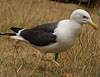 Lesser Black-backed Gull graellsii X8 4CY, July 08 2015, Rotterdam, the Netherlands. Picture: Merijn Loeve.
 Lesser Black-backed Gull graellsii DJ 9CY, July 14 2015, Utrecht, the Netherlands. Picture: Herman Bouman.
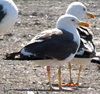 LBBG 4cy 23 July 01 2011, Amsterdam, the Netherlands. Picture: Maarten van Kleinwee.
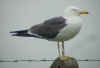 LBBG 5cy SA8 July 14 2002, Dintelhaven, Maasvlakte, the Netherlands. P3 has
been shed. Female ringed as pullus on June 20 1998.
LBBG 5cy SA8 July 14 2002, Dintelhaven, Maasvlakte, the Netherlands. P3 has
been shed. Female ringed as pullus on June 20 1998. Lesser Black-backed Gull graellsii NLA 5.505.659 3CY, July 20 2016, Utrecht, the Netherlands. Arrested moult.
 Lesser Black-backed Gull graellsii NLA 5.502.143 4CY, June
18 & July 05 2016, Katwijk, the Netherlands.
Lesser Black-backed Gull graellsii NLA 5.502.143 4CY, June
18 & July 05 2016, Katwijk, the Netherlands.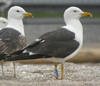 LBBG 4cy J9CP July 16 2008, Amsterdam, the Netherlands. Picture: Ruud Altenburg.
 Lesser Black-backed Gull graellsii N38F 4CY, July 05 2017, Utrecht, the Netherlands.
 Lesser Black-backed Gull 4CY, July 24 2013, Katwijk, the Netherlands.
 Lesser Black-backed Gull 4CY, July 07 2014, Katwijk, the Netherlands.
 Lesser Black-backed Gull 4CY, July 07 2014, Katwijk, the Netherlands.
 LBBG sub-adult, July 09 2013, Katwijk, the Netherlands. P1-P10 present.
 LBBG sub-adult, July 09 2013, Katwijk, the Netherlands. P1-P10 present.
 LBBG 4cy, July 18 2013, Katwijk, the Netherlands. P1-P10 present.
 LBBG 4cy, July 18 2013, Katwijk, the Netherlands. P1-P10 present.
 LBBG sub-adult, July 09 2013, Katwijk, the Netherlands. P1/P3.
 LBBG sub-adult, July 18 2013, Katwijk, the Netherlands. P1/P4.
 LBBG 4cy, July 18 2013, Katwijk, the Netherlands. P2/P4.
 LBBG 4cy, July 18 2013, Katwijk, the Netherlands. P2/P4.
 LBBG sub-adult, July 18 2013, Katwijk, the Netherlands. P2/P5.
 LBBG 4cy, July 18 2013, Katwijk, the Netherlands. P2/P5.
 LBBG sub-adult, July 09 2013, Katwijk, the Netherlands. P2/P5.
 Photo
6: sub-adult
LBBG, July 14
2001, IJmuiden, the Netherlands. Note the tips on the outer primaries.
Photo
6: sub-adult
LBBG, July 14
2001, IJmuiden, the Netherlands. Note the tips on the outer primaries.