 Lesser Black-backed Gull (graellsii & intermedius)
(last update: June 26, 2012)
lbbg 1cy May
lbbg 1cy June
lbbg 1cy July
lbbg 1cy August
lbbg 1cy September
lbbg 1cy October
lbbg 1cy November
lbbg 1cy December
lbbg 2cy January
lbbg 2cy February
lbbg 2cy Mar-April
lbbg 2cy May
lbbg 2cy June
lbbg 2cy July
lbbg 2cy August
lbbg 2cy September
lbbg 2cy October
lbbg 2cy Nov - Dec
lbbg 3cy Jan-April
lbbg 3cy May
lbbg 3cy June
lbbg 3cy July
lbbg 3cy August
lbbg 3cy September
lbbg 3cy October
lbbg 3cy Nov - Dec
lbbg sub-ad Jan-April
lbbg sub-ad May
lbbg sub-ad June
lbbg sub-ad July
lbbg sub-ad Aug
lbbg sub-ad Sept
lbbg sub-ad Oct
lbbg sub-ad Nov
lbbg sub-ad Dec
lbbg adult January
lbbg adult February
lbbg adult March
lbbg adult April
lbbg adult May
lbbg adult June
lbbg adult July
lbbg adult August
lbbg adult September
lbbg adult October
lbbg adult Nov - Dec
sub-adult: September
Regarding moult pace and strategy, sub-adults don't differ much from full adults. Sometimes it's hard to age sub-adults correct, but on average, some or all of the following features can be found in 4cy:
- relatively pale bare part coloration compared to full adults, although there is hardly any difference in most sub-adults compared to full adults;
- black markings on the old rectrices, often isolated limited black spots near the centre, although most rectrices are moulted to completely white tail-feathers by September and sub-adults with old rectrices are rare (but see image 5);
- p10 with a small mirror, p9 lacking such a mirror and very small white tips on the top of the outer primaries. By August, these tips are worn away and the primaries are brownish, strongly bleached and together with the primary coverts, the outer wing looks brownish (see this preening sub-adult, image 10). In 5cy birds, these outer primary coverts are still not really adult-like, rather blackish with white tips in some cases (see e.g. this sub-adult -presumed 5cy- in image 11);
- the grey centres of the old secondaries show a brown hue and the tips are abraded. Also, the first moulted secondaries (the outer ones, i.e. S1-S10) may, when they are still not shed, show blackish centres or fine vermiculation at the top half of the feather (see e.g. image 11, where the secondaries are just visible in the open wing);
- tertials, outer greater coverts or outer lesser coverts (in the carpal edge) show old adult-like feathers with a relative strong brown hue, obvious much stronger than expected in full adult coverts. See image 3.
Used as a single characteristic, the evidence is not very convincing, but individuals that combine these characteristics are probably 4cy or 5cy birds.
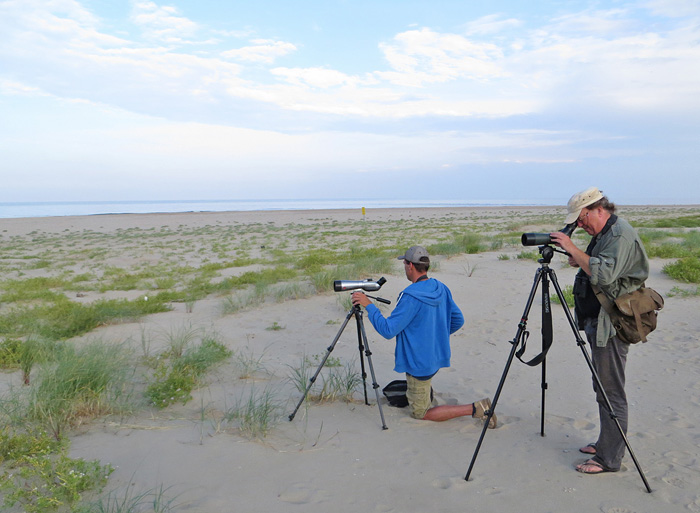
Kees Camphuysen (R) & Mars Muusse (L) scanning Texel beach for ringed gulls September 2013.
And a well deserved beer with Delfín...
Pictures: Delfín Gonzalez.
Arrested autumn primary moult in sub-adults
In autumn, LBBGs have to decide between moulting the primaries on the breeding grounds or start migrating and shed primaries after arrival in the winter quarters (or main stop-overs). This decision is made on individual considerations and strategy. Ring recoveries revealed that birds (of the same age), born in the same colony, may still be in the Netherlands by early November, while others can be found as south as Morocco. And the strategy may be changed by individuals as well; migrating south as 1cy bird, but stay in the Netherlands in 2cy. Why migration strategy differ so much between two individuals so closely related is unknown, and probably the answer can be found in their ancestors' gene flow. Whatever, the option chosen, opportunistic or conservative, it involves the primary moult schedule. By the end of August, LBBGs leave the Netherlands rapidly and at Maasvlakte numbers fall from several 10.000's to just a few 1.000's within two weeks (end of August, early September). Within those migrating groups, many adults and sub-adults leave with complete old remiges, or arrested primary moult at p1 or p2. But how to prove this hypothesis?
It's most likely that exactly those sub-adults and adults with suspended and arrested moult are very keen to move south as quick as possible and they probably do not take long breaks on minor stop-overs. For exact numbers on suspended moult, maybe best bet is Portugal or other main stop-overs which are used for a longer time (long enough the fulfill primary moult and find enough food) and check new arriving birds. Another option is video-tape migrating birds from rocky outcrops, where they pass at short distance, and base estimates on the video-stills.
So far, detailed surveys on suspended and arrested moult in (near) adult graellsii/intermedius LBBGs in autumn is lacking, but it certainly occurs, as some pictures show (see e.g. image 20 and image 21). In other sections, arrested moult or expected suspended moult is mentioned as well.
| remaining primaries in LBBG Maasvlakte - the Netherlands, 28.09.2001 - |
||||||||
| p4 | p5 | p6 | p7 | p8 | p9 | p10 | no | |
| sub-ad* | 1 | 0 | 2 | 2 | 12 | 14 | 4 | 0 |
| adult | 2 | 5 | 14 | 23 | 62 | 40 | 10 | 0 |
| * Sub-adults are presumable in 4 cy. | ||||||||
U.K.: Sub-adult graellsii
 Lesser Black-backed Gull graellsii 2CT8 4CY, September 22 2016, Leça Beach, Matosinhos, Portugal. Picture: José Marques.
 Lesser Black-backed Gull graellsii 3AP7 4CY-5CY, January 2015 - November 2016, Matosinhos Beach, Matosinhos, Portugal. Picture: José Marques.
 Lesser Black-backed Gull graellsii 5AP4 4CY, September 01 2015, Matosinhos beach, Matosinhos, Portugal. Picture: José Marques.
 Lesser Black-backed Gull graellsii 5FA2 4CY-5CY, September 2016 - March 2017, Matosinhos, Portugal. Picture: José Marques.
 Lesser Black-backed Gull graellsii 6CK2 4CY, September 08 2015, Matosinhos beach, Matosinhos, Portugal. Picture: José Marques.
 Lesser Black-backed Gull graellsii 3M5:C 4CY, September 02 2016, Leixões harbour, Matosinhos, Portugal. Picture: José Marques.
Belgium: Sub-adult graellsii "Dutch intergrades"
 Lesser Black-backed Gull 4cy HNAS September 17 2011, Boulogne sur mer, NW France. Picture: Jean-Michel Sauvage.
the Netherlands: Sub-adult graellsii "Dutch intergrades"
 LBBG Dutch intergrade 4cy NLA 5.411.538, September 02 2003, Westkapelle, the Netherlands.
 Germany: Sub-adult graellsii - intermedius transition
 Lesser Black-backed Gull graellsii HXA9 4CY, September 26 2016, Matosinhos beach, Matosinhos, Portugal. Picture: José Marques.
 LBBG 4cy H.010 September 01 2010, Westkapelle, the Netherlands.
 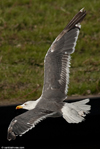 LBBG Dutch intergrade H.501 Seen as 3cy and 4cy, Leiden, the Netherlands. Pictures: Maarten van Kleinwee.
 LBBG Dutch intergrade H7.6K September 28 2009, Westkapelle, the Netherlands.
Denmark: Sub-adult intermedius
 LBBG intermedius V9PN September 23 2010, Westkapelle, the Netherlands.
Norway & Sweden: Sub-adult intermedius
 LBBG 4cy intermedius J0U5 September 20 2010, Westkapelle, the Netherlands. Arrested moult.
 LBBG intermedius JHH1 September 26 2003, IJmuiden, the Netherlands.
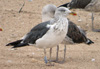 intermedius JL3G September 08 2008, Madrid, Spain. Photo by Delfín González.
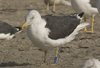 LBBG intermedius J6PH September 22 2009, IJmuiden, the Netherlands. Also as 2cy.
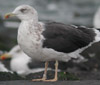 intermedius sub-adult SVS 8107139 September 24 2007, Westkapelle, the Netherlands.
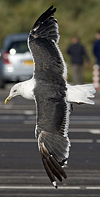 Lesser Black-backed Gull sub-adult, September 25 2012, Katwijk, the Netherlands.
 Lesser Black-backed Gull sub-adult, September 25 2012, Katwijk, the Netherlands.
 Lesser Black-backed Gull 4CY, September 11 2012, Noordwijk, the Netherlands.
 Lesser Black-backed Gull sub-adult, September 25 2012, Katwijk, the Netherlands.
 Lesser Black-backed Gull sub-adult, September 07 2015, Katwijk, the Netherlands. Arrested moult.
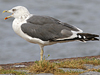 Lesser Black-backed Gull 4CY, September 03 2016, Utrecht, the Netherlands.
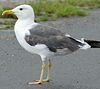 Lesser Black-backed Gull graellsii sub-adult, September 04 2015, Utrecht, the Netherlands.
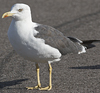 Lesser Black-backed Gull sub-adult, September 19 2013, Katwijk, the Netherlands.