 Lesser Black-backed Gull (graellsii & intermedius)
(last update:
lbbg 1cy May
lbbg 1cy June
lbbg 1cy July
lbbg 1cy August
lbbg 1cy September
lbbg 1cy October
lbbg 1cy November
lbbg 1cy December
lbbg 2cy January
lbbg 2cy February
lbbg 2cy Mar-April
lbbg 2cy May
lbbg 2cy June
lbbg 2cy July
lbbg 2cy August
lbbg 2cy September
lbbg 2cy October
lbbg 2cy Nov - Dec
lbbg 3cy Jan-April
lbbg 3cy May
lbbg 3cy June
lbbg 3cy July
lbbg 3cy August
lbbg 3cy September
lbbg 3cy October
lbbg 3cy Nov - Dec
lbbg sub-ad Jan-April
lbbg sub-ad May
lbbg sub-ad June
lbbg sub-ad July
lbbg sub-ad Aug
lbbg sub-ad Sept
lbbg sub-ad Oct
lbbg sub-ad Nov
lbbg sub-ad Dec
lbbg adult January
lbbg adult February
lbbg adult March
lbbg adult April
lbbg adult May
lbbg adult June
lbbg adult July
lbbg adult August
lbbg adult September
lbbg adult October
lbbg adult Nov - Dec
first calendar year: July
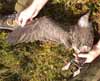
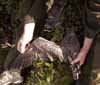
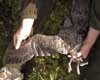
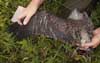
Below some example birds, ringed in Troms region, N Norway. All birds ringed July 31 2011 by Morten Helberg's team. Birds are registered here "Larus fuscus ssp", subsequent observations have to tell if they were intermedius or nominate fuscus.....
LBBG 1cy J0TK |
 LBBG 1cy J1PL |
 LBBG 1cy J2PL |
 LBBG 1cy J3PL |
 LBBG 1cy J4PL |
 LBBG 1cy J5PL |
 LBBG 1cy J6PL |
 LBBG 1cy J7PL |
 LBBG 1cy J8PL |
 LBBG 1cy J1PU |
 LBBG 1cy J3PU |
 LBBG 1cy J4PU |
 LBBG 1cy J5PU |
 LBBG 1cy J6PU |
 LBBG 1cy J7PU |
 LBBG 1cy J8PU |
LBBG 1cy J0PU |
LBBG 1cy J1PX |
 LBBG 1cy J2PX |
 LBBG 1cy J1PY |
 LBBG 1cy J5PY |
LBBG 1cy J2XL |
General notes on 1cy LBBG July
In July many Dutch juvenile LBBG from early brood are leaving the colonies. They spread to the sandy beaches near the colonies and disperse along the coast. Year 2003, the first juvenile LBBG arrived at June 30 at Westkapelle, the earliest date ever. At the beaches, 100's juveniles can be found, while in the colonies some nests still contain three young pulli. Some juveniles already start moulting the upper scapulars.
2001-2002: indication of 2nd generation feathers
 Year 2001 and 2002 we checked adult LBBG in the Maasvlakte and Dintelhaven colony. While doing our surveys, we noticed several juveniles with (what we though to be) second generation scapulars and wing-coverts. Such early replacement of wing-coverts was not described in current literature. The young were still begging at their parents for food within the colony. This was the reason for starting a more intensive research. The tables below present two surveys, initializing our 2004 research.
1cy LBBG research 2004
The first draft version (February 2004) can be found in the May section. The goals we described in this first draft appeared difficult to reach, so during the breeding season, several changes were made. First, we didn't start the ADULT LBBG research at Maasvlakte and Dintelhaven (Europoort). We postponed it and cooperated on that research with Roland-Jan Buijs, who is working in the LBBG colony at Moerdijk.
Next change: we couldn't continue to check the nests of the "100 group" (early breeders) three times a week. The impact of predation in the dense parts of the colony appeared to be unacceptable. So we followed the developments of marked nests from within a car and pulli were only measured once a week.
Tables 1cy LBBG June / July:
| new and/or missing mantle, scapulars, coverts and tertials in (still begging) juvenile LBBG in the Maasvlakte colony 16.08.2001 (n=32). | |||
| mantle | scaps | covs/tertials | # |
| 0 | 0 | 0 | 4 |
| ? | 0 | 0 | 8 |
| 0 | 1-5 | 0 | 2 |
| ? | 1-5 | 0 | 7 |
| 0 | 6-10 | 0 | 2 |
| 1-5 | 1-5 | 0 | 1 |
| 1-5 | 1-5 | 1-5 | 3 |
| ? | 1-5 | 1-5 | 1 |
| 0 | 6-10 | 1-5 | 3 |
| ? | 6-10 | 1-5 | 1 |
| start of post-juvenile moult: in (still begging) juvenile LBBG near the Maasvlakte colonies (<300 meters). Samples from July 13 2002 (with over 500 juveniles at single sites). In this sample the number of shed scapulars has beens scored, normally in the lower upper scapular region (see Section Bird Topography for explanations). In the field, it's hard to establish whether mantle feathers have been shed (although fully grown second generation mantle feathers may be recognized). When scapulars are missing this implicitly means new second generation scapulars are growing in, as the old feathers are 'pushed out' by the new ones. Note that fledged juveniles may show odd moult patterns, but in any case growing p9 and p10 seems to to finish the complete juvenile moult. In the mean time, with p9 and p10 growing, odd birds may still miss the outer greater coverts (from #10 outwards), or may miss median coverts (normally #3-6), may miss the inner greater coverts (#1-5), may miss the central tail-feathers (R1) or may miss feathers in the lowest row of lower scapulars. |
||
| score | Dintelhaven | Papegaaienbek |
| compl juv | 40 | 47 |
| worn juv | 5 | 4 |
| 1-5 miss | 3 | - |
| 6-10 miss | - | - |
| 11-20 miss | - | - |
| n: | 48 | 51 |
| compl juv: complete juvenile plumage in recently fledged juveniles, so no wear in the fringes and in some birds p8 is still the longest primary, with p9 and p10 growing (by this time many birds leave the nest site and disperse to near sandy beaches. worn juv: juvenile plumage with worn fringes in the (rear) wing-coverts and the scapulars and mantle feathers. The upper two tertials may show wear as well. In almost all birds, p10 is fully grown now. 1-5 miss: 1-5 scapulars have been shed. 6-10 miss: 6-10 scapulars have been shed. 11-20 miss: 11-20 scapulars have been shed. New feathers are growing in. Dintelhaven: score from location Dintelhaven - Maasvlakte, the Netherlands (51.57N,04.03E). See Maasvlakte map. Papegaaienbek: score from location Papegaaienbek - Maasvlakte, the Netherlands (51.57N,04.03E). See Maasvlakte map. |
||
 |
 |
 |
 |
 |
 |
 |
 |
 |
 |
 |
 |
Northern Norway: breeding ground for dark-mantled and pale-mantled LBBG
Juvenile nominate fuscus from the breeding grounds in N Europe can be found in the sections August & September. Below, we describe migration to the wintering grounds from north Norwegian ring recoveries. Five Norwegian authors, Morten Helberg, Geir Systad, Ingve Birkeland, Nils Lorentzen & Jan Bustnes published an article with this title in Ardea 97, 2009. The complete PDF can be found HERE. In this section, we only describe in short the findings regarding juveniles.
Traditionally, two subspecies of LBBG could be found in Norway: dark-mantled nominate fuscus in the north and pale-mantled intermedius in the south. Last decades, nominate fuscus breeding figures have dropped dramatically, while those figures for pale-mantled birds have increased. Nowadays (but already from the late 1980's) pale-mantled birds, either with origins in graellsii-land or colonisers from south Norwegian intermedius-land can be found way up in northern Norway.
Extensive ringing programmes in southern Norway show that juvenile intermedius follow the 'western flyway': from S Norway, through the North Sea bassin down along the Atlantic coast to the Iberian Peninsular and the west African coasts of Morocco and Mauritania. For north Norwegian populations, such migration research was unknown.
The three northernmost counties (Nordland, Troms and Finnmark) were visited from year 2000 onwards, to supply darvic rings to adults (June) and juveniles with body mass >300 gr (July). Darvic rings were used in 12 colonies, with varying numbers of breeding pairs (two pairs to 400 pairs). Three of these colonies held 'pure fuscus' while the other nine colonies held both fuscus and intermedius/graellsii in about equal portions (see Table 1).
All resights up to May 2008 are included in this research. When pulli were ringed in mixed colonies, they could not be determined to subspecies.
Between 2000-2007, 1284 juveniles were colour-ringed. 83 birds (6.5%) were resighted in 20 countries. There was a slightly higher probability of resighting juveniles from mixed colonies (7.5%, n=749) than from pure fuscus colonies (4.9%, n=535).
30% were classified as eastern migrants (eastern flyway through Finland, Black Sea, Israel to the Rift Valley) and 70% were western migrants (see figure 2, click on image for enlargement). The direction of migration was irrespective of the colony type (70% and 74% of the juveniles were western migrants in mixed and fuscus colonies respectively).
42 juveniles were seen in winter (1 November - 31 March). 29 from mixed colonies, 13 from fuscus colonies, in 12 countries. 83% of the birds were seen along the western migration route, and there was no difference between colony type. 23 juveniles (79%) from mixed colonies were seen in an area between England/France and Mauritania, 2 in Italy, 2 in Israel and 1 in Cameroon. From pure fuscus colonies, 11 were found between England and Senegal, 1 in Israel and 1 in Kenya. If birds were seen in consecutive years, it was often from the same wintering location again. Winter site fidelity appears to be high.
The probability of resightings from birds following a western route is much higher than from birds following an eastern route, as there are less observers along the eastern route. Hence, the actual proportion of juvenile birds following an eastern route will be much higher. Nevertheless, it is surprising that most of the juveniles from pure fuscus colonies (74%) had a western migration.
Table:
| Table 1: Location of LBBG study colonies in N Norway (see fig 1). Abstraction of juvenile data. |
||||||
Location: |
# breeding pairs: |
population composition: |
% L. f. fuscus |
years of ringing |
marked |
recovered |
Loppa |
50 |
mixed |
40-60 |
2003-07 |
112 |
14 |
Nordfugloy |
100 |
mixed |
40-60 |
2000-07 |
147 |
20 |
Sandvaer |
8 |
mixed |
40-60 |
2005-07 |
7 |
0 |
Musvaer |
20 |
mixed |
40-60 |
2007 |
32 |
3 |
Auvaer |
20 |
mixed |
40-60 |
2005-07 |
59 |
4 |
Eggloysa |
8 |
mixed |
40-60 |
2003-07 |
13 |
1 |
Froholman |
45 |
mixed |
40-60 |
2005-07 |
157 |
3 |
Lemmingvaer |
45 |
mixed |
40-60 |
2002-07 |
222 |
11 |
Svartskjaeran |
10 |
pure |
100 |
2005-07 |
26 |
1 |
Risoya |
2 |
mixed |
50 |
2003 |
0 |
- |
Maoya |
25 |
pure |
100 |
2002 |
0 |
- |
Horsvaer |
400 |
pure |
100 |
2005-07 |
509 |
26 |
Total: |
733 |
1284 |
83 |
|||
| Population composition: Mixed = pale and dark-mantled bird breeding together; Pure = only | ||||||
 Lesser Black-backed Gull 1cy 407K July 27 2009, Boulogne sur mer, NW France. Picture: Jean-Michel Sauvage.
 Lesser Black-backed Gull graellsii Y.ATP 1CY, July 11 2010, IJmuiden, the Netherlands.
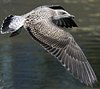 Lesser Black-backed Gull graellsii Y.BSX 1CY, July 07-22 2015, IJmuiden & Leiden, the Netherlands. Picture: Maarten van Kleinwee.
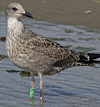 Lesser Black-backed Gull graellsii Y.BRT 1CY, July 30 2014, IJmuiden, the Netherlands.
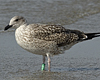 Lesser Black-backed Gull graellsii Y.BRW 1CY, July 30 2014, IJmuiden, the Netherlands.
 Lesser Black-backed Gull graellsii Y.BSJ 1CY-2CY, July 2014 & August 2015, IJmuiden, the Netherlands. Picture: Maarten van Kleinwee.
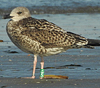 Lesser Black-backed Gull graellsii Y.BWS 1CY, June-August 2015, IJmuiden, the Netherlands. Picture: Maarten van Kleinwee.
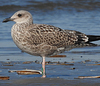 Lesser Black-backed Gull graellsii Y.BZB 1CY, July-August 2015, IJmuiden, the Netherlands. Picture: Maarten van Kleinwee.
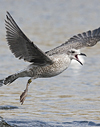 Lesser Black-backed Gull graellsii R.B 1CY, July 25 2013, Katwijk, the Netherlands.
 Lesser Black-backed Gull graellsii R.E 1CY, July 25 2013, Katwijk, the Netherlands.
 LBBG 1cy R.Z July 18 2013, Katwijk, the Netherlands.
 LBBG 1cy T.0 July 18 2013, Katwijk, the Netherlands.
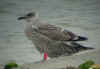 LBBG 1cy TE, July 13 2002, Dintelhaven - Maasvlakte, the Netherlands.
 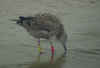 LBBG 1cy ET, July 14 2002, Dintelhaven - Maasvlakte, the Netherlands.
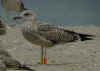 LBBG 1cy C91E, July 31 2003, Dintelhaven - Maasvlakte, the Netherlands.
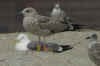 LBBG 1cy C96E, July 31 2003, Dintelhaven - Maasvlakte, the Netherlands.
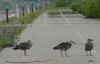 LBBG 1cy, July 13 2004, Dintelhaven - Maasvlakte, the Netherlands. Juveniles may stand motionless on the tarmac roads.
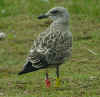 LBBG 1cy E37E, July 23 2004, Dintelhaven - Maasvlakte, the Netherlands.
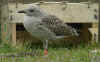 LBBG 1cy E40E, July 04 & 13 2004, Dintelhaven - Maasvlakte, the Netherlands.
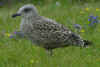 LBBG 1cy E45E, July 13 2004, Dintelhaven - Maasvlakte, the Netherlands.
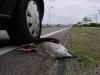 LBBG 1cy E52E, July 13 2004, Dintelhaven, the Netherlands. E52 red, hit by a
car.
LBBG 1cy E52E, July 13 2004, Dintelhaven, the Netherlands. E52 red, hit by a
car.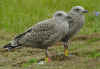 LBBG 1cy E54E, July 13 - 23 2004, Dintelhaven, the Netherlands.
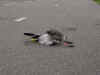 LBBG 1cy E55E, July 04 2004, Dintelhaven - Maasvlakte, the Netherlands. E55 red, or what remained of it...
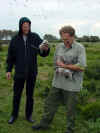 LBBG 1cy, July 04 2004, Dintelhaven - Maasvlakte, the Netherlands. Ruud Altenburg
& Mark van Leeuwen. Over 150 birds ringed this afternoon with Norman,
Theo, Ruud, Mark and Mars.
LBBG 1cy, July 04 2004, Dintelhaven - Maasvlakte, the Netherlands. Ruud Altenburg
& Mark van Leeuwen. Over 150 birds ringed this afternoon with Norman,
Theo, Ruud, Mark and Mars.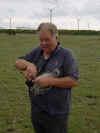 LBBG 1cy, July 04 2004, Dintelhaven - Maasvlakte, the Netherlands. Norman van Swelm.
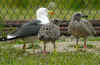 LBBG 1cy E786E & E788E, July 04 2004, Dintelhaven, the Netherlands.
 LBBG 1cy E799E& E800E, July 11 2004, Dintelhaven, the Netherlands.
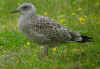 LBBG 1cy E792E, July 23 2004, Dintelhaven, the Netherlands. Nest 106.
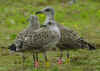 LBBG 1cy E63E & E64E, July 13 - 23 2004, Dintelhaven, the Netherlands.
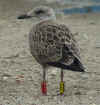 LBBG 1cy E68E, July 23 2004, Dintelhaven, the Netherlands.
 LBBG 1cy E74E & E76E, July 13 2004, Maasvlakte, the Netherlands.
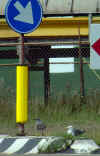 LBBG 1cy E84E, July 23 2004, Maasvlakte, the Netherlands.
 LBBG 1cy E78E, E81E
& E85E, July 13 - 23 2004, Maasvlakte, the Netherlands.
LBBG 1cy E78E, E81E
& E85E, July 13 - 23 2004, Maasvlakte, the Netherlands.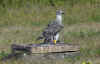 LBBG 1cy E163E, July 17 2004, Maasvlakte, the Netherlands.
 LBBG 1cy, July 11 2004, Dintelhaven - Maasvlakte, the Netherlands. Remaining project
juveniles of category II & III ringed today to darvic.
LBBG 1cy, July 11 2004, Dintelhaven - Maasvlakte, the Netherlands. Remaining project
juveniles of category II & III ringed today to darvic.