 Lesser Black-backed Gull- Kleine Mantelmeeuw (graellsii & intermedius)
(last update: May 17 2015)
lbbg 1cy May
lbbg 1cy June
lbbg 1cy July
lbbg 1cy August
lbbg 1cy September
lbbg 1cy October
lbbg 1cy November
lbbg 1cy December
lbbg 2cy January
lbbg 2cy February
lbbg 2cy Mar-April
lbbg 2cy May
lbbg 2cy June
lbbg 2cy July
lbbg 2cy August
lbbg 2cy September
lbbg 2cy October
lbbg 2cy Nov - Dec
lbbg 3cy Jan-April
lbbg 3cy May
lbbg 3cy June
lbbg 3cy July
lbbg 3cy August
lbbg 3cy September
lbbg 3cy October
lbbg 3cy Nov - Dec
lbbg sub-ad Jan-April
lbbg sub-ad May
lbbg sub-ad June
lbbg sub-ad July
lbbg sub-ad Aug
lbbg sub-ad Sept
lbbg sub-ad Oct
lbbg sub-ad Nov
lbbg sub-ad Dec
lbbg adult January
lbbg adult February
lbbg adult March
lbbg adult April
lbbg adult May
lbbg adult June
lbbg adult July
lbbg adult August
lbbg adult September
lbbg adult October
lbbg adult Nov - Dec
third calendar year (3CY): January - April
 |
 |
 |
In April only the very first of 3cy birds return to the colony. The first arrive around mid-April, the majority around mid-May in the Netherlands. They join the adults arriving as early as possible to find the best breeding spots in last years colonies. The counted maximum number of 3cy’s estimates 100 (mid-May), on the total of 1.500 LBBG present at the Maasvlakte, the Netherlands. Higher numbers can be found on the wintering grounds (Portuguese coast and in S France) or at the stop-over places (e.g. Pas-de Calais).
moult stage in typical 3cy LBBG:
It is important to distinguish between 'typical' 3cy LBBG and advanced birds. The activity in moult during April is virtually zero in typical LBBG, what has long been considered typical graellsii. In these typical birds, there has been no moult on the wintering grounds and returning 3cy birds in spring show more or less the same plumage as the plumage of 2cy October birds. They have a worn second generation tail, i.e. a tail with a black, broad sub-terminal tail-band, which has been required last autumn in the complete moult. Some birds will start or have started moulting some of the tail-feathers by April. The primaries are slightly worn at the tips, but still all second generation.
Otherwise, these typical 3cy birds still show brownish second generation wing-coverts (greaters and lessers at least) while upper-parts and bare parts look very adult-like, resulting in the well-known "grey saddle" in 3cy LBBG in spring.
moult in advanced 3cy LBBG:
By April, groups of 3cy LBBG increasingly include advanced birds, most obvious advanced in the upper-parts and wing-coverts. It's not uncommon to find 3cy LBBG with recently replaced wing-coverts in April, indicating that these feathers have been replaced on the wintering grounds, during the last months. Such birds may show complete adult-like upper-parts and the dark grey-tone of the new scapulars and coverts suggest they may origin from intermedius colonies. However, they may also return in Dutch colonies, as this image shows. It is worth checking the tail, secondaries and primaries in such birds, as advanced partial moult in the upper-parts may correlate with moult in these tracts as well.
tail-feather & primary moult in advanced LBBG:
Most commonly seen at this age now, is a worn second generation tail. But remember that quite some 2cy LBBG return in NW Europe with second generation tail-feathers in spring, and renew these tail-feathers in a second wave in the complete summer moult. Consequently, such birds may already show an almost complete white tail by October in second calendar year (see here). Therefore, it is possible that 2cy LBBG leave NW Europe with already a white tail and show white tails in spring again.
3cy LBBG in spring may include tail-feathers in the partial spring moult again, and may still be actively replacing rectrices in April (see e.g. this image). About 30% of the 3cy LBBG have moulted one or more tail feathers by the end og April, giving them the blocked pattern of white (third or fourth generation feathers) and partial black tail-feathers. The partial moult involves rectrices randomly, creating an unpredictable black and white tail in spring.
At the end of April only the very advanced birds have started the complete moult and have shed P1. The ordinary moult-sequence of the secondaries start when P6 is almost fully grown, by mid-summer. But here again, primaries and secondaries may be included in the partial moult on the wintering grounds. This image nicely illustrates arrested primary moult in spring 3cy LBBG. On the wintering grounds, partial moult must have been very extensive in the upper-parts, as almost all wing-coverts are very adult-like. In this extensive moult, the inner primaries were moulted as well, just as most of the tail-feathers.
In this respect, the western taxa intermedius and graellsii LBBG may resemble eastern fuscus., which very commonly replaced remiges and rectrices on the wintering grounds.


3CY Lesser Black-backed Gull with classic pattern on 2nd gen flight feathers: primaries and secondaries with extensive brown brown on inner primaries, often complete outerwebs dark brown, lacking well demarcated sub-terminal markings. Tail classic 2nd gen: broad tail-band over all feathers. Obvious division between grey scapulars (grey 'saddle') and brown wing-coverts.


3CY Lesser Black-backed Gull with classic pattern on 2nd gen primaries and secondaries: extensive brown brown on inner primaries, often complete outerwebs dark brown, lacking well demarcated sub-terminal markings. Tail might be anything from classic 2nd gen (broad tail-band over all feathers) to completely white tail.

4CY Lesser Black-backed Gull. Almost similar to 3CY bird above, when you compare tail and combination of brown and grey wing-coverts. However, note difference in secondaries and primaries. Inner primaries P1-P2 adult-like grey and central primaries with black sub-terminal markings and clear-cut white tips. Secondaries with broad white tips, and especially innermost secondaries show adult-like grey base.

sub-adult Lesser Black-backed Gull. Almost similar to adult birds, with adult-like inner primaries and central primaries with black sub-terminal markings and clear-cut white tips. Secondaries with broad white tips.
3cy LBBG graellsii from the UK
.
 Lesser Black-backed Gull graellsii F:035 3CY, April 08 2016, Matosinhos beach, Matosinhos, Portugal. Picture: José Marques.
 Lesser Black-backed Gull graellsii F:046 3CY-4CY, April 2016 - January 2017, Matosinhos beach, Matosinhos, Portugal. Picture: José Marques.
 Lesser Black-backed Gull graellsii C:17 3CY, April 30 2016, Azurara, Vila do Conde, Portugal. Picture: José Marques.
 LBBG 3cy F1J March 15 2009, Madrid, Spain. Picture: Delfín González.
 LBBG 3cy 6XF March 09 2006, Madrid, Spain. Picture: Delfín González.
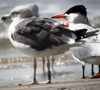 LBBG
3cy 6T5 October 02 2010, Quarteira, Faro, Portugal & February 15 2012, Tanji, The Gambia.
Photo's: Michael Davis & Clive Barlow. Active primary moult!!!
LBBG
3cy 6T5 October 02 2010, Quarteira, Faro, Portugal & February 15 2012, Tanji, The Gambia.
Photo's: Michael Davis & Clive Barlow. Active primary moult!!! Lesser Black-backed Gull graellsii 0CS3 3CY, March 25 2016, Matosinhos beach, Matosinhos, Portugal. Picture: José Marques.
 Lesser Black-backed Gull graellsii 3FF0 3CY, January 20 2017, Matosinhos beach, Matosinhos, Portugal. Picture: José Marques.
 Lesser Black-backed Gull graellsii 4CN0 3CY, February & October 2016, Matosinhos beach, Matosinhos, Portugal. Picture: José Marques.
 Lesser Black-backed Gull graellsii 7CN2 3CY, March 22 2016, Praia de Angeiras, Matosinhos, Portugal. Picture: José Marques.
 Lesser Black-backed Gull graellsii 9FC4 3CY, February 09 2017, Matosinhos, Portugal. Picture: José Marques.
 Lesser Black-backed Gull graellsii 9FF3 2CY-3CY, January 2016 - July 2017, Matosinhos, Portugal. Picture: José Marques.
 Lesser Black-backed Gull graellsii NDN.U 3CY, January - March 2016, Matosinhos, Portugal. Picture: José Marques.
  LBBG 3cy CSU April 02 2006, Madrid, Spain. Picture: Delfín González. Also as 6cy.
 LBBG 3cy UNH February 26 2006, Madrid, Spain.
 LBBG 3cy 4XF February 11 2007, Madrid, Spain. Picture: Delfín González. Also as 4-5cy Febr.
 Lesser Black-backed Gull graellsii 3XF 3CY, April 03 2015, Leixões port, Matosinhos, Portugal. Picture: José Marques.
 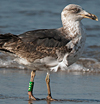 Lesser Black-backed Gull graellsii 4VF 3CY, April 07 2015, Matosinhos beach, Matosinhos, Portugal. Picture: José Marques.
 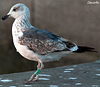 Lesser Black-backed Gull graellsii 8XF 3CY, March 15 2015, Matosinhos beach, Matosinhos, Portugal. Picture: José Marques.
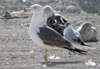 LBBG 3cy 3NF March 28 2009, Madrid, Spain. Photo by Delfín González.
 LBBG 3cy ACN April 06 2008, Madrid, Spain. Picture: Delfín González.
 LBBG 3cy CCE January 11 2009, Madrid, Spain. Picture: Delfín González. Also seen as Dec 3cy.
 LBBG 3cy D:Z February 26 2006, Madrid, Spain. Picture: Delfín González.
 Lesser Black-backed Gull graellsii x Herring Gull argenteus F2 hybrid A+G 3CY, April 08 2016, Matosinhos Beach, Matosinhos, Portugal. Picture: José Marques.
  LBBG 3cy M:J March 20 & June 29 2006, Spain & Belgium. Picture: Delfín González & Marc Fasol. Seen again in Belgium, March & June 2006.
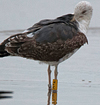 Lesser Black-backed Gull graellsii A+Z 3CY, March - April 2015, Matosinhos Beach, Matosinhos, Portugal. Picture: José Marques.
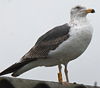 Lesser Black-backed Gull graellsii C+K 3CY, April 24 2015, Leixões harbour, Matosinhos, Portugal. Picture: José Marques.
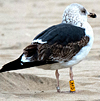 Lesser Black-backed Gull graellsii S+K 3CY, March 30 2015, Matosinhos Beach, Matosinhos, Portugal. Picture: José Marques.
 LBBG 3cy W0NJ March 30 2006, Westkapelle, the Netherlands. Picture Pim Wolf.
 LBBG 3cy WB3X March 02 2008, Madrid, Spain. Photo by Delfín González.
 LBBG 3cy R0PD April 01 2007, Madrid, Spain. Photo by Delfín González.
 LBBG 3cy R6PJ March 09 2008, Madrid, Spain. Photo by Delfín González.
3cy LBBG graellsii "Dutch intergrade" from France
.
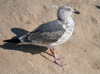 LBBG 3cy 820N March 14 2010, Madrid, Spain. Photo by Delfín González.
3cy LBBG graellsii from France
.
 Lesser Black-backed Gull graellsii 3:ABN 3CY, March 21 2016, Matosinhos beach, Matosinhos, Portugal. Picture: José Marques.
 Lesser Black-backed Gull graellsii 3:ARS 3CY-4CY, April 2016 & January - March 2017, Matosinhos beach, Matosinhos, Portugal. Picture: José Marques.
 Lesser Black-backed Gull graellsii 3:AUV 3CY, April 05 2016, Matosinhos beach, Matosinhos, Portugal. Picture: José Marques.
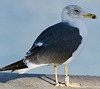 Lesser Black-backed Gull graellsii R:T1A 3CY-4CY, April 2015 & March 2016, Leixões harbour, Matosinhos, Portugal. Picture: José Marques.
3cy LBBG graellsii "Dutch intergrade" from Belgium
.
 Lesser Black-backed Gull graellsii B.NAP 3CY, January 14 2017, Matosinhos beach, Matosinhos, Portugal. Picture: José Marques.
 LBBG 3cy DPAS April 08 2008, Madrid, Spain. Picture: Delfín González.
 LBBG 3cy HHAS January 02 2010, Madrid, Spain. Picture: Delfín González.
 Lesser Black-backed Gull graellsii RN.AU 2CY-3CY, June 2016 - March 2017, Aveiro, Portugal. Picture: José Marques.
 LBBG 3cy BLB L-111037 April 22 2006, Dordrecht, the Netherlands.
3cy LBBG graellsii "Dutch intergrade" from the Netherlands
.
 LBBG 3cy K.NAZ January 05 2009, Madrid, Spain. Picture: Delfín González.
 Lesser Black-backed Gull graellsii K.BJM 3CY, April 05 2016, Matosinhos beach, Matosinhos, Portugal. Picture: José Marques.
 Lesser Black-backed Gull graellsii K.BJC 3CY-4CY, April 2016 & January - March 2017, Leixões harbour, Matosinhos, Portugal. Picture: José Marques.
 Lesser Black-backed Gull graellsii K.AZX 2CY-5CY, August 2014 - January 2017, the Netherlands & Portugal. Picture: Maarten van Kleinwee & José Marques.
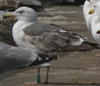 LBBG 3cy KAMU April 24 2013 & June 16 2013, the Netherlands. Picture Herman Bouman & Ruud Altenburg.
 LBBG 3cy E471 February 25 2007, Madrid, Spain. Photo by Delfín González.
 LBBG 3cy 46 April 22 2013, Utrecht, the Netherlands. Picture: Herman Bouman.
 Lesser Black-backed Gull graellsii JV 3CY, March 09 2017, Matosinhos, Portugal. Picture: José Marques.
 Lesser Black-backed Gull graellsii V3 3CY, March 09 2017, Matosinhos, Portugal. Picture: José Marques.
 Lesser Black-backed Gull graellsii Z.C 3CY, April 06 2016, Matosinhos beach, Matosinhos, Portugal. Picture: José Marques.
 LBBG 3cy Y8 April 14 2012, Outreau-Boulogne, NW France. Picture: Jean-Michel Sauvage.
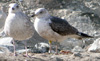 LBBG 3cy YF March 29 2009, Madrid, Spain. Photo by Delfín González.
 LBBG 3cy XZ January 05 2009, Madrid, Spain. Photo by Delfín González.
 LBBG 3cy KD March 2008 - March 2009, Madrid, Spain. Picture: González & Martin.
 LBBG 3cy JG April 2008 - March 2009, Madrid, Spain. Picture: González & Martin.
 LBBG 3cy GZ January 18 2009, Madrid, Spain. Picture: Delfín González. Also seen as 2cy Nov.
 LBBG 3cy GN April 05 2009, Madrid, Spain. Picture: Delfín González.
 LBBG 3cy FP January 04 2009, Madrid, Spain. Picture: Delfín González.
 LBBG 3cy D7 January 18 2009, Madrid, Spain. Photo by Delfín González.
 LBBG 3cy SV March 29 2009, Madrid, Spain.
 LBBG 3cy UH January 18 2009, Madrid, Spain.
 LBBG 3cy 8C January 02 2010, Madrid, Spain. Picture: Delfín González. Also as 2cy Febr.
 LBBG 3cy NLA 6.125.099 March 26 2006, Dordrecht, the Netherlands.
 LBBG 3cy NLA 5.412.239 April 14 2006, Dordrecht, the Netherlands.
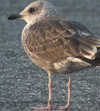 LBBG 3cy NLA 5.414.454 January 21 2006, Amsterdam, the Netherlands.
3cy LBBG graellsii - intermedius from N Germany
.
 LBBG 3cy H3E2 March 04 2012, Madrid, Spain. Picture: Delfín González.
 LBBG 3cy HR22 January 15 2012, IJmuiden, the Netherlands.
  Lesser Black-backed Gull graellsii HE3E9 3CY, January - March 2017, Leixões harbour, Matosinhos, Portugal. Picture: José Marques.
 Lesser Black-backed Gull graellsii HE7E3 1CY-3CY, October 2015 - March 2017, the Netherlands & Portugal. Picture: Mars Muusse & José Marques.
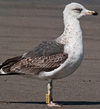 Lesser Black-backed Gull graellsii HX858 3CY, March 23 2015, Matosinhos Beach, Matosinhos, Portugal. Picture: José Marques.
 LBBG 3cy H560 March 15 2009, Madrid, Spain. Photo by Delfín González.
 LBBG 3cy H66H February 25 2007, Madrid, Spain. Photo by Delfín González.
3cy LBBG intermedius from Denamrk
.
 LBBG 3cy V4PE March 30 2008, Madrid, Spain. Photo by Delfín González.
 LBBG 3cy V398 January 09 2010, Madrid, Spain. Photo by Delfín González.
 Lesser Black-backed Gull intermedius V.Z6Y 3CY, January 05 2017, Anza fish company, Agadir, Morocco. Picture: Maarten van Kleinwee.
Active primary moult!!!.
3cy LBBG intermedius from Norway
.
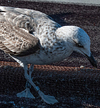 Lesser Black-backed Gull intermedius J043K 3CY, February 09 2015, Leixões harbour, Matosinhos, Portugal. Picture: José Marques.
 Lesser Black-backed Gull intermedius J221N 1CY-3CY, December 2015 - April 2016, November 2016 & April 2017, Matosinhos, Portugal. Picture: José Marques.
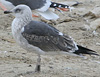 Lesser Black-backed Gull intermedius J418L 3CY, February 06 2016, Comenar Viejo, Madrid, Spain (40°15'41"N 003°38'00"W). Picture: Delfín Gonzalez.
 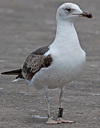 Lesser Black-backed Gull intermedius J514E 3CY, April 17 2015, Leixões Harbour, Matosinhos, Portugal. Picture: José Marques.
 LBBG 3cy J3R1 February 21 2009, Anza-Agadir, Morocco. Picture: Morten Helberg.
 LBBG 3cy JT0X 3CY, March 08 2014, Ashdod, Israel. Picture: Amir Ben Dov.
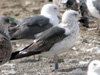 LBBG 3cy J0JK March 24 2008, Madrid, Spain. Photo by Delfín González.
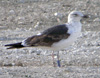 LBBG 3cy J7ZT March 30 2008, Madrid, Spain. Photo by Delfín González.
3cy LBBG graellsii / intermedius ringed in winter
.
 Lesser Black-backed Gull graellsii F666 3CY, March 11 2016, Matosinhos Beach, Matosinhos, Portugal. Picture: José Marques.
 Unringed 3cy LBBG
 LBBG 3cy April 30 2014, Katwijk, the Netherlands.
  LBBG 3cy April 30 2014, Katwijk, the Netherlands.
  LBBG 3cy April 30 2014, Katwijk, the Netherlands. Classic bird with 2nd gen flight feathers.
  LBBG 3cy April 09 2006, Dordrecht, the Netherlands.
  LBBG 3cy April 09 2006, Dordrecht, the Netherlands.
  LBBG 3cy April 14 2006, Dordrecht, the Netherlands.
 3cy LBBG arrested moult
.
LBBG
3cy 6T5 October 02 2010, Quarteira, Faro, Portugal & February 15 2012, Tanji, The Gambia.
Photo's: Michael Davis & Clive Barlow. Active primary moult!!!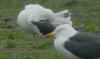 LBBG 3cy April 19 2003, e-on - Maasvlakte, the
Netherlands. Arrested primary moult at P7.
LBBG 3cy April 19 2003, e-on - Maasvlakte, the
Netherlands. Arrested primary moult at P7.