 Herring Gull (argentatus & argenteus)
(last update: February 11, 2013)
Herring Gull - 3cy February
 |
 |
 |
 |
50 shades of grey - upperpart grey tones in gulls
Googling 'shades of grey', gulls may not be the first images turning up on your screen, and in fact and to much surprise, there may not be too many gulls in the story of the bestselling book. Still, the pictures are catching, even for the Dutch larophile and may juice the story below.
Several Nearctic species have been recorded in The Netherlands, like Ring-billed Gull, Bonapartes Gull and Franklin's Gull. Which species can be expected next? And which plumage may be the most rewarded to look for? Based on sightings of rare gulls in the Western Palearctic a list of species was created and birds were assigned to 5 groups. Every group contains rare species together with the most similar looking common species.
Group 1
Common Gull - Mew Gull - Ring-billed Gull
Group 2
Thayer’s Gull -
Kumlien’s Gull - Iceland Gull
Group 3
Great Black-backed Gull - Kelp Gull - Slaty-backed Gull
Group 4
Glaucous-winged Gull - Glaucous Gull
Group 5
Herring Gull - American Herring Gull - Vega Gull


Group 2 50 shades of grey: Thayer’s Gull - Kumlien’s Gull - Iceland Gull
Generally believed to be a cline, some treat them as separate species: from east to west Iceland Gull glaucoides breeding on Greenland, Thayer's Gull thayeri breeding in the western Hudson Bay and the population of Kumlien's Gull kumlieni breeding inbetween. Thayer's Gull has a strong SE migration route, with many birds wintering on the West Coast, but part of the population heads due south to winter in Texas and further east along the coast or remain further north in the Great Lake district. Greenland glaucoides has a main wintering area in the rich fish grounds near Greenland, and Kumlien's Gull can be found in large numbers in Newfoundland, with the most famous 'Quidi Vidi Lake' attracting people who like to study this taxon. Due to the very inaccessible breeding grounds there are still no detailed studies on the individual variation of these three taxa.
Severe winters may bring larger flocks of Iceland Gulls into West European waters and such flocks may also bring us some Kumlien's Gull, of which a few have been documented already for The Netherlands. Thayer's Gull is a rare vagrant, mainly to Ireland, with no records for The Netherlands, but has been recorded as close as Denmark, so surely a candidate.
IMMATURE ICELAND GULL GLAUCOIDES VS KUMLIEN'S GULL KUMLIENI
Probably a large proportion of immature birds will be impossible to safely assign to one of these two taxa. However, the most obvious birds are still eye-catching, nicely illustarted below with the first two images. Points to consider are:
- darkness of outerwebs of the outer primaries,
- secondary bar,
- uniform colour of tail band,
- pigmentation in the very tips of the outer primaries.
 |
 |
Iceland Gull (glaucoides) 1st cycle, February 14 2009, Peterhead, Scotland (Chris Gibbins). Classic glauoides. White outer primaries; arrow points probably faded away by February. Such white winged individuals pose no problems. |
Kumlien's Gull (kumlieni) 1st cycle, January 20 2013, Michigan City, IN. (Amar Ayyash). Dark outer-webs on primaries, secondary bar darker than wing-coverts and dark solid tail bar. |
 |
5a.jpg) |
Iceland Gull (glaucoides)? 1st cycle, February 02 2008, British westcoast (Chris Gibbins). Darker end of the spectrum, dark on underparts. Arrow points at primaries and juvenile plumage.Outer-webs of visible primaries lack dark patches. |
Kumlien's Gull kumlieni 1st cycle, St. John's, Newfoundland (Dave Brown). Dark centres on rectrices, dark outer primaries and extensive dark centres on tertials. Birds like this should be eye-catching: glaucoides in jizz, with dark elements. |
 |
 |
Iceland Gull (glaucoides) 1st cycle, February 26 2012, Peterhead, Scotland (Chris Gibbins). Rather dark-winged Iceland Gull, with the outer-webs of the primaries all darker than inner ones. Still, there is a uniform pattern, as this pattern is repeated across all primaries, with inner primaries darker, if anything, than outers. In typical glaucoides, the very tip of the outer-webs are white, with obvious chevrons or ´arrow-head patterns´ on the central and inner primaries. Also, there is extensive spotting just above the chevrons, continuing to halfway the feathers in P1-P3, and less extensive central primaries, but even still obvious on P6. This pattern is copied on the tips of the greater primary coverts, and worth checking, as patterns on exposed primary tips can easily bleach and wear away (making exact valuation of original patterns difficult), while the primary coverts are often hidden in resting birds so patterns are better conserved. |
Kumlien's Gull (kumlieni) 1st cycle, January 23 2013, St. John's, Newfoundland (Jan Baert). Pale bird, close to some 1st cycle glaucoides, but: |
 |
 |
Iceland Gull (glaucoides) 1st cycle, December 20 2011, Neeltje Jans, the Netherlands (Edward Minnaar). Slight contrast in shade of grey-brown on primaries, with outer-webs of outer primaries darker than the inners (which advocates kumlieni). Sub-terminal chevrons most obvious on inner primaries. Pattern of tail-band broken by much vermiculation, where typical kumlieni shows a more solid band, especially on the centres of the feathers. Also secondary centres do not form a darker band. |
Kumlien's Gull (kumlieni) 1st cycle (2CY), February 14 2015, Madison, CT (Keith Mueller). Outerwebs on outer primaries are darkest part of the primaries, the secondary bar is darker than the brown tone on the wing-coverts and this bird has a dark solid tail bar. This combination should place the bird outside the limits for glaucoides. |
 |
 |
Iceland Gull (glaucoides) 1cy, December 04 2010, Fraserburgh, Scotland (Chris Gibbins). Pale individual, with whitish outerwebs of outer primaries, whitish centres of secondaries, but surprisingly solid dark centres of rectrices. |
Kumlien's Gull kumlieni 1st cycle, December 30 2010 (Ryan J Sanderson). Warm reddish brown patterns, as in many glaucoides. Typically kumlieni has the outerwebs of the outer primaries darker than other parts of the primaries. Also, the outerwebs of the secondaries are dark, creating a dark secondary band in flight (here this effect is gone, the band in interrupted, now the bird is landing). Finally, kumlieni often has solid dark centres on rectrices. |

1st CYCLE THAYER'S GULL VS EUROPEAN HERRING GULLS
Probably most difficulties arise to identify 1st cycle Thayer's Gull in a group of argenteus / argentatus Herring Gulls. Key points to check 1st cycle birds are:
- outer primaries have pale innerwebs, so pale window of inner primaries more or less continues all the way to P10,
- ‘frosty’ upperparts due to very whitish fringed scapulars and wing coverts; in flight the wings look very silvery,
- resting birds show dark brown primaries with pale crescent
tips,
- almost completely dark brown tail,
- tertials with solidly brown centres,
- heavy, dense barring on uppertail and undertail coverts,
- three-coloured scapular pattern: pale brown centre, dark sub-terminal line, pale fringe,
- round-headed and finer billed than Herring Gull,
- late moult.
 |
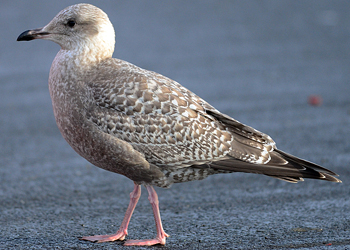 |
Herring Gull (argentatus) 1st cycle RUM ES14266 October 22 2012, Scheveningen, the Netherlands (Mars Muusse). Ringed in Murmansk, N Russia. In Herring Gull the juvenile scapulars are two-toned, not three-coloured: brown centre and pale notches. |
Thayer's Gull 1st cycle, January 28 2012, Pacific County, WA (Charlie Wright). Round headed, fine billed. Dark tertial centres and three-coloured juvenile scapulars. |
 |
 |
| American Herring Gull smithsonianus 1st cycle 1106-13848 December 07 2013, New Buffalo (Amar Ayyash). Hatched at latitude 45,11N showing completely 2nd gen scapulars by early December. Such extensive post-juvenile moult not seen in Thayer's Gull. | Thayer's Gull 1st cycle, December 10 2011, Everett, WA. (Steve Mlodinow). Still completely juvenile. Three-coloured juvenile scapulars: pale brown centre, dark sub-terminal line, pale fringe. |
 |
 |
American Herring Gull smithsonianus 1st cycle, December 11 2013, Tompkins Co, NY. (Kevin McGowan). Like Thayer's Gull, largely juvenile plumage (probably from northern population). These northern birds often powerful, heavy built and pear-shaped head ('snouty'). |
Thayer's Gull 1st cycle, November 05 2010, Fernhill, OR. (Birdmeister). Three-coloured juvenile scapulars: pale brown centre, dark sub-terminal line, pale fringe. Still completely juvenile plumage. |
 |
 |
American Herring Gull smithsonianus 1st cycle, November 19 2011, Berrien County (Amar Ayyash). Uppertail coverts and tail pattern similar to Thayer's Gull, but pale window restricted to inner primaries. |
Thayer's Gull 1st cycle, February 05 2011, Westmoreland Park, OR. (John Rakestraw). Bird in juvenile plumage by February. Black bill with paler base. Note extensive dark tertial centres and pale crescents on primary tips. |
 |
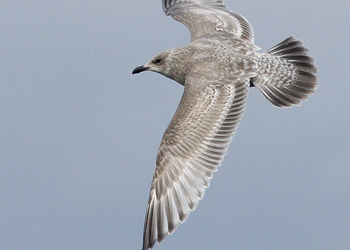 |
Herring Gull 1st cycle, February 07 2013, Katwijk, the Netherlands (Mars Muusse). Different from Thayer's in following respects: much proximal white in rectrices, pale-looking uppertail coverts, window restricted to inner primaries, no pale innerwebs on outer primaries. |
Thayer's Gull 1st cycle, February 16 2010, Winthrop Harbor, IL (Erik Bruhnke). Pale window continues to the inner webs of the outer primaries (base of innerweb of P10 pale). No dark pigmentation on the innerweb tips of P1-P4. Tail largely blackish. Uppertail coverts densely barred. |
 |
 |
Herring Gull 1st cycle, February 14 2012, Noordwijk, the Netherlands (Mars Muusse). Sometimes Herring Gull show paler innerwebs on outer primaries, but then birds are very pale overall, especially on rump and in the tail. |
Thayer's Gull 1st cycle, February 03 2013, Boulder County, CO. (Amar Ayyash). Pale window continues to the inner webs of the outer primaries (base of innerweb of P10 pale). No dark pigmentation on the innerweb tips of P1-P4. Tail largely blackish. Uppertail coverts densely barred. |
. IMMATURE THAYER'S GULL VS EUROPEAN HERRING GULLSAn extensive PDF has been published by Chris Gibbins, dealing with 2nd cycle Thayer's Gull. His key points for 2nd cycle Thayer's are: . |
|
 |
 |
Herring Gull (argentatus) 2nd cycle JN336 January 09 2012, Neeltje Jans, the Netherlands (Pim Wolf). From N Norway (70°23'N). No grey scapulars Note broad barring on tertial tips and barring on inner greater coverts. |
Thayer's Gull 2nd cycle, February 24 2009, Vancouver Island, BC (Guy Monty). Delicately built. 2nd generation primaries, pink base of bill and single grey-based feathers in scapular region. Note pattern on tertials and greater coverts. |
 |
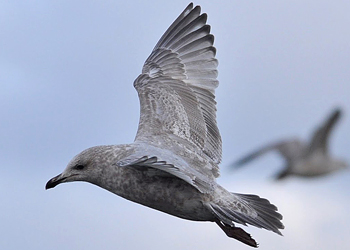 |
Herring Gull (argentatus) 2nd cycle KV48 January 15 2008, Boulogne-sut-Mer, France (Jen-Michel Sauvage). From Murmansk, Russia (67°05'N). Northern argentatus often have 'snouty' head: long bill and sloped forehead. Bulky structure and stronger head-bill proportions than Thayer's. Only tiny white tips on 2nd gen outer primaries. |
Thayer's Gull 2nd cycle, December 08 2012, Lake County, IL (Amar Ayyash). 2nd gen flight feathers, P10 with 'ghost mirror'. Fine vermiculation on the tips of P1-P4. Scapular region almost completely grey, but still intermixed with faint grown feathers. Tail almost completely dark and bill predominantly dark. |
 |
 |
Herring Gull 2nd cycle, January 23 2013, Katwijk, the Netherlands (Mars Muusse). Outer primaries with dark innerwebs. Some birds have a weak mirror on 2nd generation P10. Much proximal white in tail and markings on uppertail coverts is widely spaced. |
Thayer's Gull thayeri 2nd cycle (3CY), December 28 2012, Half Moon Bay, CA. (Chris Gibbins). Notice the dark secondaries of this Thayer's, matching the primaries and tail in tone. In Kumlien's all three of these feather groups are normally significantly paler brown than in Thayer's. |
 |
 |
Herring Gull 2nd cycle, October 09 2012, Katwijk, the Netherlands (Mars Muusse). Overall dark bird, outer & central primaries with dark innerwebs. Much black in tail and strong contrast with pale uppertail coverts. |
Thayer's Gull thayeri 2nd cycle (3CY), December 28 2012, Half Moon Bay, CA. (Chris Gibbins). Notice the contrast between the outer and inner webs and the dark reaching the primary coverts on the outer 6 (perhaps even 7) primaries, the lack of any mirrors and the dark secondaries. In large gulls the outer web of primary 10 is always narrower than it is on the other feathers. Because of this, on taxa such as Thayer's and Kumlien's which have a contrast between the outer and inner webs, the dark on primary 10 appears more restricted than on the other feathers. Bear this in mind when assessing dark versus pale areas. |
Feb16.jpg) |
 |
Kumlien's Gull (kumlieni) 2nd cycle, February 16 2012, St John's, Newfoundland (Dave Brown). Many grey scapulars. Primaries pale brown with broad pale fringes, tertials and greater coverts with much vermiculation and spotting. Note overall 'milky' tone. |
Thayer's Gull thayeri 2nd cycle (3CY), February 12 2012, Sausalito, CA. (Steve Hampton). Typical second cycle bird. Tertials extensively solid dark brown lacking vermiculation at fringes. Note the rather solid brown, slightly marbled greater coverts. |
 |
 |
Kumlien's Gull (kumlieni) 2nd cycle, January 22 2012, St John's, Newfoundland (Bruce Mactavish). Few adult-like grey scapulars; bird very 'milky' overall. Primaries pale brown with broad pale fringes, tertials and greater coverts with much spotting. |
Thayer's Gull thayeri 2nd cycle (3CY), February 18 2012, Davis, CA. (Steve Hampton). Advanced bird with almost completely grey saddle. Dark centres of tertials. Outer primaries darkest part in resting bird (dark brown, not blackish), lacking Kumlien's broad white fringes. |

The chart above was created by Howell & Elliott to score adult birds from the glaucoides-kumlieni-thayeri complex. Birds are considered adult when primary coverts, tertials and tail are adult-like, without dark markings or brownish wash. When such a bird is found in The Netherlands, it is good to consider some features:
| trait | Iceland Gull glaucoides | Kumlien's Gull kumlieni | Thayer's Gull thayeri |
| 1. UPPERPARTS | Kodak 3-4: pale grey | Kodak 4-5: pale grey | Kodak 5-6: pale grey |
| 2. HEAD STREAKING | faded pale brown & limited | dusky head and neck | extensively 'hooded' |
| 3. IRIS | no / very few spots |
speckled iris | honey, amber or completely dark eye in most. |
| 4. WINGTIP | figure A, or B as darkest limit (chart above) | anything from Figure B-O | Figure R (above) or even more black on P5 |
| 5. PIGMENTATION OUTERWEB P9-P10 | grey pattern just discernible | wide range of pale grey to dark grey, almost blackish | pattern is blackish |
 |
 |
Iceland Gull (glaucoides) adult, January 13-14 2012, Peterhead, Scotland (Chris Gibbins). Classic bird, but with speckled iris. Unmarked white wingtip. Pearl-grey upperparts. |
Iceland Gull (glaucoides) adult, January 21 2012, Peterhead, Scotland (Chris Gibbins). Glaucoides population homogeneous: pearl grey upperparts; no sub-terminal bands; at most only very faint parallel grey lines on P9-P10 along feather edges; no speckling in iris. |
 |
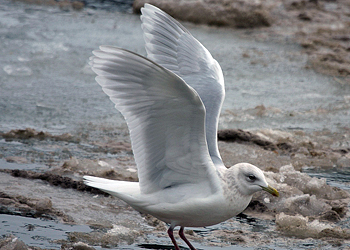 |
Kumlien's Gull (kumlieni) adult, February 07 2012, St John's, Newfoundland (Dave Brown). Bird too dark for glaucoides and yellowish iris is extensively mottled brown. Wingtip in palest end of spectrum for kumlieni. |
Kumlien's Gull (kumlieni) adult, February 10 2007, St John's, Newfoundland (Chris Gibbins). Wingtip in palest end of spectrum for kumlieni, lacking sub-terminal bands. However, parallel dark lines along edges of P7-P10. Pigmentation is pale grey. |
 |
 |
Kumlien's Gull (kumlieni) adult,, February 07 2012, St John's, Newfoundland (Dave Brown). Still wingtip in palest end of spectrum for kumlieni, lacking sub-terminal bands. However, parallel dark lines along edges of P7-P10. Pigmentation is dark grey. Upperpart grey tone darker than glaucoides. |
Kumlien's Gull (kumlieni) adult, January 23 2013, St. John's, Newfoundland (Jan Baert). Sub-terminal bands and lines along edges of P7-P10. Pigmentation is pale grey. Bird with pale iris. |
 |
 |
Kumlien's Gull (kumlieni) adult, February 10 2007, St John's, Newfoundland (Chris Gibbins). Restricted pattern on primaries; albeit limited, the pigmentation is dark grey. |
Kumlien's Gull (kumlieni) adult, January 23 2013, St John's, Newfoundland (Jan Baert). About average: obvious sub-terminal bands. Pigmentation is medium grey. Pale iris. |
|---|---|
 |
 |
Kumlien's Gull (kumlieni) adult, February 10 2007, St John's, Newfoundland (Chris Gibbins). Darkest end of spectrum: much pattern on outer primaries plus pigmentation is dark grey. |
possible Kumlien's Gull (kumlieni) x Thayer's Gull (thayeri) adult, February 12 2007, St John's, Newfoundland (Chris Gibbins). Outside safe limits for kumlieni; pigmentation is blackish and extensive, full medial band on P10, heavy bird (compared to kumlieni), completely dark iris, hooded winter streaking all pointing to influences of thayeri. |
| SELECTION OF ADULT HERRING GULLS | SELECTION OF ADULT THAYER'S GULL (THAYERI) |
 |
 |
| American Herring Gull (smithsonianus) adult, May 09 2009, Newfoundland (Scott Grant). Orange orbital ring and staring yellow iris. | Thayer's Gull (thayeri) adult, January 17 2004, Capitola, CA (Jeff Poklen). Iris uniformly dark brown, purple orbital ring, rounded head, weak gonys angle, extensive 'hooded' winter streaking. |
 |
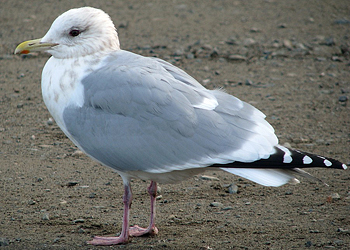 |
| Herring Gull argenteus KN May 09 2006, Moerdijk, the Netherlands (Mars Muusse) Speclked iris on male argenteus. Head shape far too powerful for thayeri, and note orangey yellow orbital ring (instead of purple). | Thayer's Gull (thayeri) adult, February 22 2008, Vancouver Island, BC (Guy Monty). Dark iris, purple orbital ring, still winter head streaking by February and even in march. Even (larger) males often rather elegant compared to Herring Gull. |
 |
 |
| Herring Gull argenteus NH 16 May 16 2006, Moerdijk, the Netherlands (Theo Muusse). Thayeri pattern combined with sub-terminal band on P10 on female argenteus. Orbital ring is yellow, iris is not speckled. | Thayer's Gull adult, January 20 2008, Vancouver Island, BC. (Guy Monty). Birds in winter (non breeding) plumage. Each spring a significant percentage of the world population of this species masses in this area to fatten up on Pacific Herring and their roe during the annual spawn. |
 |
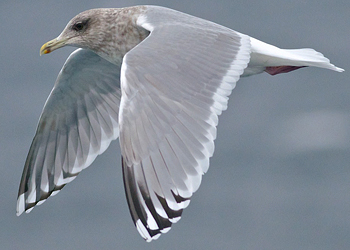 |
| Herring Gull argenteus HP May 05 2006, Moerdijk, the Netherlands (Theo Muusse). Thayeri pattern combined with sub-terminal band on female argenteus. Much black on innerweb of P9. Orbital ring is yellow, iris is not speckled. | Thayer's Gull (thayeri) sub-adult, February 11 2012, Pelagic off Lewes, DE (Adrian Hinkle). Note thayeri pattern on P9-P10, no black on P5. |
 |
 |
Herring Gull adult, January 23 2013, Katwijk, the Netherlands (Mars Muusse). With thayeri pattern on P9-P10. |
Thayer's Gull adult, March 07 2011, Vancouver Island, BC (Guy Monty). Upper bird: P10 with broken sub-terminal band and single spot on P5. Lower bird: No sub-terminal black on P10, single spot on P5. Both bird with broken medial bands, so-called "thayeri pattern". |
 |
 |
Herring Gull argentatus adult, December 06 2013, Noordwijk, the Netherlands (Mars Muusse). Grey tone as in argentatus from N Scandinavia. P9 and P10 no sub-terminal band and no medial band; hardly any black on innerweb. P6 black on outer-web only. Just within limits of argentatus, or argentatus x hyperboreus. |
Thayer's Gull thayeri adult, February 11 2012, Pelagic - Lewes, DE (BirdFellow). Dark iris and mottling on head running down on breast. Obvious thayeri pattern on P9 (broken medial band). |
Group 1
Common Gull - Mew Gull - Ring-billed Gull
Group 2
Thayer’s Gull -
Kumlien’s Gull - Iceland Gull
Group 3
Great Black-backed Gull - Kelp Gull - Slaty-backed Gull
 Herring
Gull (argenteus) 3CY BTO GR-35748 February 10 2013, Boulogne-sur-Mer, NW France. Picture: Jean-Michel Sauvage.
Herring
Gull (argenteus) 3CY BTO GR-35748 February 10 2013, Boulogne-sur-Mer, NW France. Picture: Jean-Michel Sauvage. Herring Gull (argenteus) PFAB 3CY, February 05 2012, Nieuwpoort, Belgium. Picture: Peter Adriaens.
 Herring Gull (argenteus) 3cy PJAD February 03 2012, Vlissingen, the Netherlands. Also as 1cy.
 Herring
Gull H-152167 3cy (argenteus), February 23 2007, Oostende, Belgium. Picture Ies Meulmeester.
Herring
Gull H-152167 3cy (argenteus), February 23 2007, Oostende, Belgium. Picture Ies Meulmeester. Herring
Gull H-117774 3cy (argenteus), February 07 2003, Boulogne/Mer,
France (50.43N 01.37E). This individual was seen on several
occasions from October 2001 - February 2003.
Herring
Gull H-117774 3cy (argenteus), February 07 2003, Boulogne/Mer,
France (50.43N 01.37E). This individual was seen on several
occasions from October 2001 - February 2003. Herring
Gull H-113894 3cy (argenteus), February 07 2003, Boulogne/Mer,
France (50.43N 01.37E). This individual was seen on many
occasions between July 2002 - February 2003.
Herring
Gull H-113894 3cy (argenteus), February 07 2003, Boulogne/Mer,
France (50.43N 01.37E). This individual was seen on many
occasions between July 2002 - February 2003. Herring
Gull H-xxxxxx 3cy (argenteus), February 06 2003, Boulogne/Mer,
France (50.43N 01.37E).
Herring
Gull H-xxxxxx 3cy (argenteus), February 06 2003, Boulogne/Mer,
France (50.43N 01.37E). Herring Gull (argenteus) 9||5 3CY, January - February 2019, Katwijk, the Netherlands.
 Herring Gull (argenteus) 0|K 3CY, February 11 2019, Katwijk, the Netherlands.
 Herring Gull (argenteus) 3||B 3CY, February 27 2019, Katwijk, the Netherlands.
 Herring Gull (argenteus) 6||1 2CY-3CY, September 2018 & February 2019, IJmuiden & Katwijk, the Netherlands.
 Herring Gull 7||K 3CY-4CY, February 2018 & February 2019, Katwijk, the Netherlands.
 Herring Gull 9||1 2CY-3CY, February 2018 & February 2019, Katwijk, the Netherlands.
  Herring Gull (argenteus) A||V 1CY-3CY, October 2016 - February 2018, Katwijk, the Netherlands.
 Herring Gull C= 3CY, February - March 2017, IJmuiden, the Netherlands.
 Herring Gull (argenteus) 8K / rr 3CY, January - February 2019, Katwijk, the Netherlands.
 Herring Gull 16 3CY, February 22 2018, Katwijk, the Netherlands.
  Herring Gull (argenteus) Y.BMD 1CY-4CY, August 2013 - April 2016, IJmuiden, the Netherlands.
 Herring Gull (argenteus) K.CJM 2CY-3CY, October 2018 - February 2019, Katwijk, the Netherlands.
 Herring
Gull P.CJF 3cy (argenteus), December 2010 & February 2011, Scheveningen, the Netherlands.
Herring
Gull P.CJF 3cy (argenteus), December 2010 & February 2011, Scheveningen, the Netherlands. Herring Gull argenteus LP 3CY, February 2015, Scheveningen, the Netherlands. Picture: Merijn Loeve.
  Herring Gull argenteus SX 2CY-3CY, January 2014 & February 2015, Rotterdam, the Netherlands. Picture: Merijn Loeve.
  Herring Gull (argenteus) NLA 6.179.193 2CY-3CY, September 2018 & February 2019, Westkapelle & Katwijk, the Netherlands.
 Herring
Gull 5.361.1?? 3cy (argenteus), February 04 2002, IJmuiden,
the Netherlands (52.27N 04.33E).
Herring
Gull 5.361.1?? 3cy (argenteus), February 04 2002, IJmuiden,
the Netherlands (52.27N 04.33E). Herring
Gull 5.?? 3cy (argenteus), February 21 2002, Scheveningen,
the Netherlands.
Herring
Gull 5.?? 3cy (argenteus), February 21 2002, Scheveningen,
the Netherlands. Herring Gull argentatus HM53 2CY-3CY, December 2014 & February 2015, Barneveld, the Netherlands. Picture: Merijn Loeve.
  Herring Gull (argentatus) DKC 4407767 3CY, February 24 2016, IJmuiden, the Netherlands.
.jpg) Herring
Gull (argentatus) J2145 3cy, January-February 2012, Scheveningen, Netherlands.
Herring
Gull (argentatus) J2145 3cy, January-February 2012, Scheveningen, Netherlands. Herring Gull argentatus J7222 2CY-3CY, February 2014 & February 2015, Rotterdam Zuid, the Netherlands. Picture: Merijn Loeve.
  Herring Gull (argentatus) J7304 3CY, February 11 2015, Hovindam - Oslo, Norway. Picture: John Sandøy.
.jpg) Herring Gull (argentatus) J7564 3CY, March 04 2015, Hovindam - Oslo, Norway. Picture: John Sandøy.
Herring Gull (argentatus) J7564 3CY, March 04 2015, Hovindam - Oslo, Norway. Picture: John Sandøy. Herring Gull (argentatus) J7813 3CY, February 11 2015, Hovindam - Oslo, Norway. Picture: John Sandøy.
.jpg) Herring Gull (argentatus) J782A 3CY, February 04 2015, Hovindam - Oslo, Norway. Picture: John Sandøy.
Herring Gull (argentatus) J782A 3CY, February 04 2015, Hovindam - Oslo, Norway. Picture: John Sandøy. Herring Gull
(argentatus) JL045 3CY, February - March 2015, IJmuiden, the Netherlands.
Herring Gull
(argentatus) JL045 3CY, February - March 2015, IJmuiden, the Netherlands. Herring
Gull KV48 3cy (argentatus), February 2008, Boulogne/Mer, France.
Herring
Gull KV48 3cy (argentatus), February 2008, Boulogne/Mer, France. Herring Gull (argentatus) RUM ES-023655 1CY-3CY, November 2018, March 2019, November 2019 & February 2020, Katwijk, the Netherlands.
 Herring Gull (argentatus) RUM ES27859 2CY-3CY, January 14 - February 27 2019 & February 2020, Katwijk, the Netherlands.
.jpg) Herring Gull argentatus LVR xx 3CY, February 15 2015, Rumbula (Getliņi) rubbish dump, Stopiņu, Latvia (56°53'10"N, 24°15'45"E). Picture: Igor Denisov.
Herring Gull argentatus LVR xx 3CY, February 15 2015, Rumbula (Getliņi) rubbish dump, Stopiņu, Latvia (56°53'10"N, 24°15'45"E). Picture: Igor Denisov. Herring Gull 3CY, February 25 2019, Katwijk, the Netherlands.
 Herring Gull 3CY, February 25 2019, Katwijk, the Netherlands.
 Herring Gull 3CY, February 25 2019, Katwijk, the Netherlands.
 Herring Gull 3CY, February 25 2019, Katwijk, the Netherlands.
 Herring Gull 3CY, February 11 2019, Katwijk, the Netherlands.
 Herring Gull 3CY, February 11 2019, Katwijk, the Netherlands.
 Herring Gull 3CY, February 11 2019, Katwijk, the Netherlands.
 Herring Gull 3CY, February 11 2019, Katwijk, the Netherlands.
 Herring Gull 3CY, February 12 2018, Katwijk, the Netherlands.
 Herring Gull 3CY, February 12 2018, Katwijk, the Netherlands.
 Herring Gull 3CY, February 12 2018, Katwijk, the Netherlands.
 Herring Gull 3CY, February 12 2018, Katwijk, the Netherlands.
 Herring Gull 3CY, February 12 2018, Katwijk, the Netherlands.
 Herring Gull 3CY, February 12 2018, Katwijk, the Netherlands.
 Herring Gull 3CY, February 12 2018, Katwijk, the Netherlands.
 Herring Gull 3CY, February 12 2018, Katwijk, the Netherlands.
 Herring Gull 3CY, February 12 2018, Katwijk, the Netherlands.
 Herring Gull 3CY, February 12 2018, Katwijk, the Netherlands.
 Herring Gull 3CY, February 12 2018, Katwijk, the Netherlands.
 Herring Gull 3CY, February 12 2018, Katwijk, the Netherlands.
 Herring Gull 3CY, February 12 2018, Katwijk, the Netherlands.
 Herring Gull 3CY, February 12 2018, Katwijk, the Netherlands.
 Herring Gull 3CY, February 02 2018, Katwijk, the Netherlands.
  Herring Gull 3CY, February 02 2018, Katwijk, the Netherlands.
  Herring Gull 3CY, February 02 2018, Katwijk, the Netherlands.
  Herring Gull 3CY, February 02 2018, Katwijk, the Netherlands.
  Herring Gull 3CY, February 02 2018, Katwijk, the Netherlands.
  Herring Gull 2nd cycle (3CY), February 02 2016, Katwijk, the Netherlands.
 Herring Gull 2nd cycle (3CY), February 02 2016, Katwijk, the Netherlands.
 Herring Gull 2nd cycle (3CY), February 02 2016, Katwijk, the Netherlands.
 Herring Gull 2nd cycle (3CY), February 02 2016, Katwijk, the Netherlands.
 Herring Gull 2nd cycle (3CY), February 02 2016, Katwijk, the Netherlands.
 Herring Gull 2nd cycle (3CY), February 02 2016, Katwijk, the Netherlands.
 Herring Gull 2nd cycle (3CY), February 02 2016, Katwijk, the Netherlands.
 Herring Gull 2nd cycle (3CY), February 02 2016, Katwijk, the Netherlands.
 Herring Gull 2nd cycle (3CY), February 02 2016, Katwijk, the Netherlands.
 Herring Gull 2nd cycle (3CY), February 02 2016, Katwijk, the Netherlands.
 Herring Gull 2nd cycle (3CY), February 02 2016, Katwijk, the Netherlands.
 Herring Gull 2nd cycle (3CY), February 02 2016, Katwijk, the Netherlands.
 Herring Gull 2nd cycle (3CY), February 02 2016, Katwijk, the Netherlands.
 Herring Gull 2nd cycle (3CY), February 02 2016, Katwijk, the Netherlands.
 Herring Gull 2nd cycle (3CY), February 02 2016, Katwijk, the Netherlands.
 Herring Gull 2nd cycle (3CY), February 02 2016, Katwijk, the Netherlands.
 Herring Gull 2nd cycle (3CY), February 02 2016, Katwijk, the Netherlands.
 Herring Gull 2nd cycle (3CY), February 02 2016, Katwijk, the Netherlands.
 Herring Gull 2nd cycle (3CY), February 02 2016, Katwijk, the Netherlands.
 Herring Gull 2nd cycle (3CY), February 02 2016, Katwijk, the Netherlands.
 Herring Gull 2nd cycle (3CY), February 02 2016, Katwijk, the Netherlands.
 Herring Gull 2nd cycle (3CY), February 02 2016, Katwijk, the Netherlands.
 Herring Gull 2nd cycle (3CY), February 02 2016, Katwijk, the Netherlands.
 Herring Gull 2nd cycle (3CY), February 02 2016, Katwijk, the Netherlands.
 Herring Gull 2nd cycle (3CY), February 02 2016, Katwijk, the Netherlands.
 Herring Gull 2nd cycle (3CY), February 02 2016, Katwijk, the Netherlands.
 Herring Gull 2nd cycle (3CY), February 02 2016, Katwijk, the Netherlands.
 Herring
Gull 3cy (argenteus), February 27 2012, Noordwijk, the Netherlands.
Herring
Gull 3cy (argenteus), February 27 2012, Noordwijk, the Netherlands. Herring
Gull 3cy, February 07 2013, Katwijk, the Netherlands.
Herring
Gull 3cy, February 07 2013, Katwijk, the Netherlands. Herring
Gull 3cy (argentatus), February 07 2013, Katwijk, the Netherlands.
Herring
Gull 3cy (argentatus), February 07 2013, Katwijk, the Netherlands. Herring
Gull 3cy, February 07 2013, Katwijk, the Netherlands.
Herring
Gull 3cy, February 07 2013, Katwijk, the Netherlands. Herring
Gull 3cy, February 25 2012, Noordwijk, the Netherlands.
Herring
Gull 3cy, February 25 2012, Noordwijk, the Netherlands. Herring
Gull 3cy, February 25 2012, Noordwijk, the Netherlands.
Herring
Gull 3cy, February 25 2012, Noordwijk, the Netherlands. Herring
Gull 3cy, February 25 2012, Noordwijk, the Netherlands.
Herring
Gull 3cy, February 25 2012, Noordwijk, the Netherlands. Herring
Gull 3cy, February 25 2012, Noordwijk, the Netherlands.
Herring
Gull 3cy, February 25 2012, Noordwijk, the Netherlands. Herring Gull 3CY, February 03 2014, Katwijk, the Netherlands.
  Herring Gull 3CY, February 03 2014, Katwijk, the Netherlands.
  Herring Gull 3CY, February 03 2014, Katwijk, the Netherlands.
  Herring Gull 3CY, February 21 2014, Katwijk, the Netherlands.
  Herring Gull 3CY, February 21 2014, Katwijk, the Netherlands.
  Herring Gull 3CY, February 21 2014, Katwijk, the Netherlands.
  Herring Gull 3CY, February 21 2014, Katwijk, the Netherlands.
  Herring Gull 3CY, February 21 2014, Katwijk, the Netherlands.
  Herring Gull 3CY, February 11 2014, Katwijk, the Netherlands.
  Herring
Gull 3cy (argenteus), February 07 2013, Katwijk, the Netherlands.
Herring
Gull 3cy (argenteus), February 07 2013, Katwijk, the Netherlands. Herring
Gull 3cy (argenteus), February 07 2013, Katwijk, the Netherlands.
Herring
Gull 3cy (argenteus), February 07 2013, Katwijk, the Netherlands. Herring Gull 3CY, February 21 2014, Katwijk, the Netherlands.
  Herring Gull 3CY, February 17 2015, Katwijk, the Netherlands.
  Herring Gull 3CY, February 17 2015, Katwijk, the Netherlands.
  Herring Gull 3CY, February 19 2015, IJmuiden, the Netherlands.
  Herring Gull 3CY, February 19 2015, IJmuiden, the Netherlands.
  Herring Gull 3CY, February 19 2015, IJmuiden, the Netherlands.
  Herring Gull 3CY, February 19 2015, IJmuiden, the Netherlands.
  Herring Gull 3CY, February 19 2015, IJmuiden, the Netherlands.
  Herring Gull 3CY, February 19 2015, IJmuiden, the Netherlands.
  Herring Gull 3CY, February 03 2014, Katwijk, the Netherlands.
  Herring
Gull 3cy (argentatus), February 27 2012, Noordwijk, the Netherlands.
Herring
Gull 3cy (argentatus), February 27 2012, Noordwijk, the Netherlands. Herring Gull 3CY, February 19 2015, IJmuiden, the Netherlands.
  Herring Gull 3CY, February 19 2015, IJmuiden, the Netherlands.
  Herring Gull 3CY, February 19 2015, IJmuiden, the Netherlands.
  Herring Gull 3CY, February 19 2015, IJmuiden, the Netherlands.
  Herring
Gull 3cy (argenteus), February 04 2002, IJmuiden, the
Netherlands (52.27N 04.33E).
Herring
Gull 3cy (argenteus), February 04 2002, IJmuiden, the
Netherlands (52.27N 04.33E). Herring
Gull 3cy (argenteus), February 07 2002, IJmuiden, the
Netherlands (52.27N 04.33E).
Herring
Gull 3cy (argenteus), February 07 2002, IJmuiden, the
Netherlands (52.27N 04.33E). Herring
Gull 3cy (argenteus), February 07 2002, IJmuiden, the
Netherlands (52.27N 04.33E).
Herring
Gull 3cy (argenteus), February 07 2002, IJmuiden, the
Netherlands (52.27N 04.33E). Herring
Gull 3cy (argenteus), February 19 2004, IJmuiden, the
Netherlands (52.27N 04.33E).
Herring
Gull 3cy (argenteus), February 19 2004, IJmuiden, the
Netherlands (52.27N 04.33E). Herring
Gull 3cy (argentatus), February 09 2003,
Boulogne/Mer, France (50.43N 01.37E).
Herring
Gull 3cy (argentatus), February 09 2003,
Boulogne/Mer, France (50.43N 01.37E). Herring
Gull 3cy (argentatus), February 09 2003,
Boulogne/Mer, France (50.43N 01.37E).
Herring
Gull 3cy (argentatus), February 09 2003,
Boulogne/Mer, France (50.43N 01.37E). Herring
Gull 3cy (argentatus), February 09 2003,
Boulogne/Mer, France (50.43N 01.37E).
Herring
Gull 3cy (argentatus), February 09 2003,
Boulogne/Mer, France (50.43N 01.37E)..jpg) Herring
Gull 2cy (argenteus), February 01 2012, Scheveningen, the Netherlands.
Herring
Gull 2cy (argenteus), February 01 2012, Scheveningen, the Netherlands. Herring
Gull 3cy (argentatus), February 09 2003,
Boulogne/Mer, France (50.43N 01.37E).
Herring
Gull 3cy (argentatus), February 09 2003,
Boulogne/Mer, France (50.43N 01.37E).