Herring Gull- Zilvermeeuw (argentatus & argenteus)
(last update:
Herring Gull plumages:
hg 1cy July
hg 1cy August
hg 1cy September
hg 1cy October
hg 1cy November
hg 1cy December
hg 2cy January
hg 2cy February
hg 2cy March
hg 2cy April
hg 2cy May
hg 2cy June
hg 2cy July
hg 2cy August
hg 2cy September
hg 2cy October
hg 2cy November
hg 2cy December
hg 3cy January
hg 3cy February
hg 3cy March
hg 3cy April
hg 3cy May
hg 3cy June
hg 3cy July
hg 3cy August
hg 3cy September
hg 3cy October
hg 3cy November
hg 3cy December
hg sub-ad January
hg sub-ad February
hg sub-ad March
hg sub-ad April
hg sub-ad May
hg sub-ad June
hg sub-ad July
hg sub-ad August
hg sub-ad September
hg sub-ad October
hg sub-ad November
hg sub-ad December
hg ad January
hg ad February
hg ad March
hg ad April
hg ad May
hg ad June
hg ad July
hg ad August
hg ad September
hg ad October
hg ad November
hg ad December
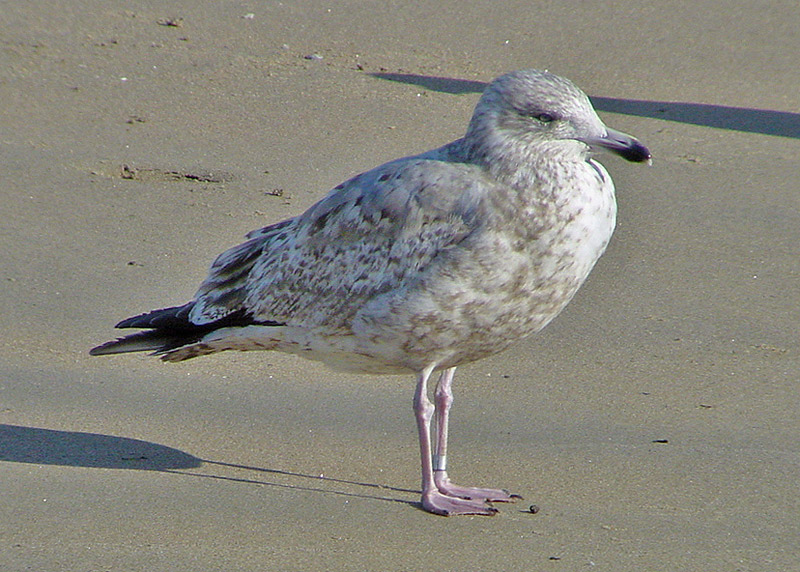
Herring Gull 5.xxx.xxx3cy (argenteus), February 21 2003, Scheveningen, the Netherlands.
A typical argenteus
ringed in the
Netherlands: Arnhem Ringstation 5.??.
The brown second generation primaries
lack a mirror on P10. The second generation tail has a broad dark
tail-band.
The
new scapulars are more
or less uniform grey with just a few patterned brownish feathers left in
the rear upper and lower scapulars. Some grey scapulars appear abraded at the
fringes already, especially in the upper scapulars. Still, many scapulars
show an obvious second-generation like pattern.
This Dutch individual has moulted upper tertials and wing-coverts to third
generation feathers in the partial autumn moult: the two upper tertials
have been replaced, greater coverts #1-3 have been replaced, the innermost
and outer median coverts and outer lower lesser coverts have been replaced. The
new feathers look fresher compared to adjacent feathers. The patterns is very similar to
the second generation feathers, although most are typically grey-based
with
faint sub-terminal markings and a pronounced shaft streak.