Mediterranean Gull- Zwartkopmeeuw (L. melanocephalus)

(last update: 11-3-2008)


Mediterranean Gulls, July 30 2001, Le Portel, NW France. By the end of July, already 100's of Mediterranean Gulls are present, including juveniles, summer plumage adults and winter plumage adults. They feed at the beach and flocks of a few hundreds may rest at the rocks, right beneath the village. 


LEFT: adult Mediterranean Gull, March 18 2003.

Mediterranean Gulls used to breed in a restricted area in the countries north of the Mediterranean, the Black Sea and east to Dagestan. When Karel Voous wrote his Atlas of European Birds (1965) the distribution of this species was so limited that he suggested that it might be heading for extinction. Since the late 1980’s this species has spread north and the world population has increased spectacularly. It now breeds regularly in Belgium, the Netherlands, England, Ireland, Hungary and Poland. After the breeding season, Mediterranean Gull disperse westwards and can be found south along the Moroccan Atlantic coast and along the coasts of the Mediterranean. Large flocks congregate at the beaches of Boulogne-sur-Mer (NW France) from August to October, later moving southwards. In early spring tens of thousands can be seen at Cambrils on the north-eastern coast of Spain.

Most images on this page were taken at Le Portel / Boulogne-sur-Mer, France (50.42. 20 N,01.34.03 E).  Le Portel is known to be one of the best sites to see Mediterranean Gulls with numbers exceeding 3.000 individuals during some autumns. As can be seen in the images, many individuals are colour ringed or metal ringed, and come from Mediterranean Gull populations from all over Europe. Colour-ringing Mediterranean Gulls started in The Netherlands in 1989 with only a handful of birds. Twenty years on thousands of birds have been colour-ringed and at the start of 2008 there are tens of projects all over Europe.

Mediterranean Gull is a medium sized gull, with an intense black head in adult summer and rather pale grey upper-parts. Easy clues for identification and ageing in Mediterranean Gull are the median coverts and outer primaries. Most of the description below follows P.J. Grant: "Gulls, a guide to identification".

1CY MEDITERRANEAN GULL

In juvenile plumage, the head is uniform pale buffish-brown with slightly darker ear-coverts and a pale throat. Juvenile birds have a blackish smudge in front of the eye and white crescents above and below the eye. The brown colour of the head extends onto the neck, forming a barred collar running down along the sides of the breast to the flanks. The under-parts and rump are white. The scapulars and mantle feathers are deep brown with an inconspicuous dark sub-terminal band and a silvery-white fringe, creating a scaly pattern.

The pattern of the scapulars is repeated on the lesser coverts, lower lesser coverts, median coverts, inner three to four greater coverts and upper tertials which also show brown centres and neat silvery-white fringes. They contrast strongly with the central and outer greater coverts, which are predominantly grey, forming a pale bar in the dark inner-wing in flight, as the secondaries are dark blackish-centred as well (but with broad white tips). The inner primaries are largely white-grey, the grey slightly decreasing in the primaries outwards, reduced to parts of the inner-webs in the outer primaries P9 and P10. The under-wing coverts are all-white, but there are neat black tips on the under-wing greater primary coverts. The white tail has a clear-cut black sub-terminal band, widest on t1-2, very thin on the outer rectrices (t6 can be completely white). The iris is dark brown, the legs are usually very dark horn, the bill is blackish.

The complete juvenile plumage lasts for only a short period in Mediterranean Gulls as they start to moult soon after fledging. This post-juvenile moult is a partial moult into so-called "first winter" plumage that starts from the moment the birds leave their colonies in July and will be finished by late September. This moult includes most of the head and body feathers. The head and under-parts become almost completely white, with a dark mask of variable size and intensity behind the eye extending as very narrow streaks over the nape. The eye-crescents are white and the dark smudge in front of the eye contrasts more than in full juvenile plumage. The second generation wing-coverts, mantle and scapular feathers are plain pale grey. The rich brown centres of the juvenile wing-covert centres bleach to a foxy brown and the white fringes quickly wear away. In most birds at least some wing-coverts are included in the post-juvenile moult. The extent of this covert moult is variable, in a few birds nearly all are moulted, in others all juvenile coverts are retained until the next complete moult that starts in May of the next year. All juvenile feathers show wear by September, contrasting with the recently moulted second generation feathers. The base of the bill starts to turn paler and the legs turn slightly paler as well.

Note that the comments on moult are based on observations of juveniles from and in Western Europe. More easterly fledged Mediterranean Gulls may postpone their moult to first winter until later in the autumn and very fresh looking juveniles may be encountered well into October.

2CY MEDITERRANEAN GULL

The next moult in Mediterranean Gull is again a partial moult, from February to April and includes body and head resulting in a so-called "first summer" plumage. Most noticeable is the replacement of head feathers: the head becomes much darker with some birds developing a full hood, but many only have some black flecking. The remiges and rectrices remain juvenile and by April have become bleached and abraded. Some individuals include inner wing-coverts in this partial moult, but the juvenile outer wing-coverts are retained and therefore very abraded. The colour of bare parts become more adult-like, with the bill-base turning paler red-orange. Most birds have extensive black on the bill tip, most prominent on the lower mandible. This is the most variable plumage in Med Gull since the appearance of 2cy birds depends on the combination of the extent of the post-juvenile moult, and bleaching and wear in the winter quarters

From May to September, the first complete moult takes place, into so-called "second winter" plumage. The head pattern resembles the pattern in first winter birds, with a blackish mask behind the eye. The mantle, scapulars, tertials and all wing-coverts are replaced with plain pearl-grey feathers. The secondaries are as in adult birds, pale grey with a white tip. The second generation primaries are much paler than the first juvenile primaries, but still not nearly all-white as in adults. After finishing this complete moult a 2cy Mediterranean Gull in autumn has a diagnostic wing-tip pattern with a variable amount of black on P5-P10. P5 has only a small black sub-terminal spot, becoming gradually larger on the outer primaries as the black patch "eats up" the white along the edge of the outer-web, most prominent on P9-P10. In some birds, the outer greater primary coverts and rarely the alula coverts may show dark markings as well. The bill is orangey-red with a dark sub-terminal band. The legs are dull red or more obvious orangey-red. As with 2cy birds there is individual variation in this age group but it is less pronounced and mostly involves the amount of black in the outer primaries and the colour of the bill.

3CY MEDITERRANEAN GULL
Next moult in Mediterranean Gull is again a partial moult, from February to April and includes body and head, bringing birds in so-called "second summer" plumage. Most noticeable is the replacement of head feathers: the head becomes darker with birds developing a full hood, some still show limited flecking. The white tips of the primaries become slightly worn. The colour of bare parts become adult-like, with the orbital ring and bill turning coral red, the bill often with a thin black bill-band. The legs are scarlet red. The iris turns deep reddish-brown.

From late summer to September, a complete moult takes place, into so-called "third winter" or "adult winter" plumage. The head pattern resembles the pattern in first winter birds, with blackish mask behind the eye. The mantle, scapulars, tertials and all the wing-coverts are replaced for plain pearl-grey feathers. The secondaries are completely white. The adult primaries are shiny pearly-grey, flashing white at a distance. There is a black line along the outer-web of P10 (and sometimes on P9 as well). Secondaries, under-wing and tail all completely white. The bare part coloration in adult plumage: Iris brown, orbital ring red or orangey-red, the bill red or orangey-red with a black bill-band and a yellowish tip and the legs dull reddish or dark.

The next moult in Mediterranean Gull is again a partial moult, from February to April and includes body and head, bringing birds in so-called "second summer" plumage. Most noticeable is the replacement of head feathers: the head becomes darker with most birds developing a full hood, some still show limited flecking. The white tips of the primaries become slightly worn. The colour of bare parts become adult-like, with the orbital ring and bill turning coral red, the bill often with a black bill-band of varying width. The legs are scarlet red. The iris turns deep reddish-brown. As with 2CY birds there is individual variation in this age group but it is less pronounced and mostly involves the amount of black in the outer primaries and the fullness of the hood.

From June to September, a complete moult takes place, into so-called "third winter" or "adult winter" plumage. The head pattern resembles the pattern in first winter birds, with blackish mask behind the eye. The mantle, scapulars, tertials and all the wing-coverts are replaced for plain pearl-grey feathers. The secondaries are completely white. The adult primaries are shiny pearly-grey, flashing white at a distance. There is a black line along the outer-web of P10 (and sometimes on P9 as well). Secondaries, under-wing and tail all completely white. The bare part coloration in adult plumage: Iris brown, orbital ring red or orangey-red, the bill red or orangey-red with a black bill-band and a yellowish tip and the legs dull reddish or dark. There is some variation in 3cy and 4cy wing-tip patterns.

ADULT MEDITERRANEAN GULL

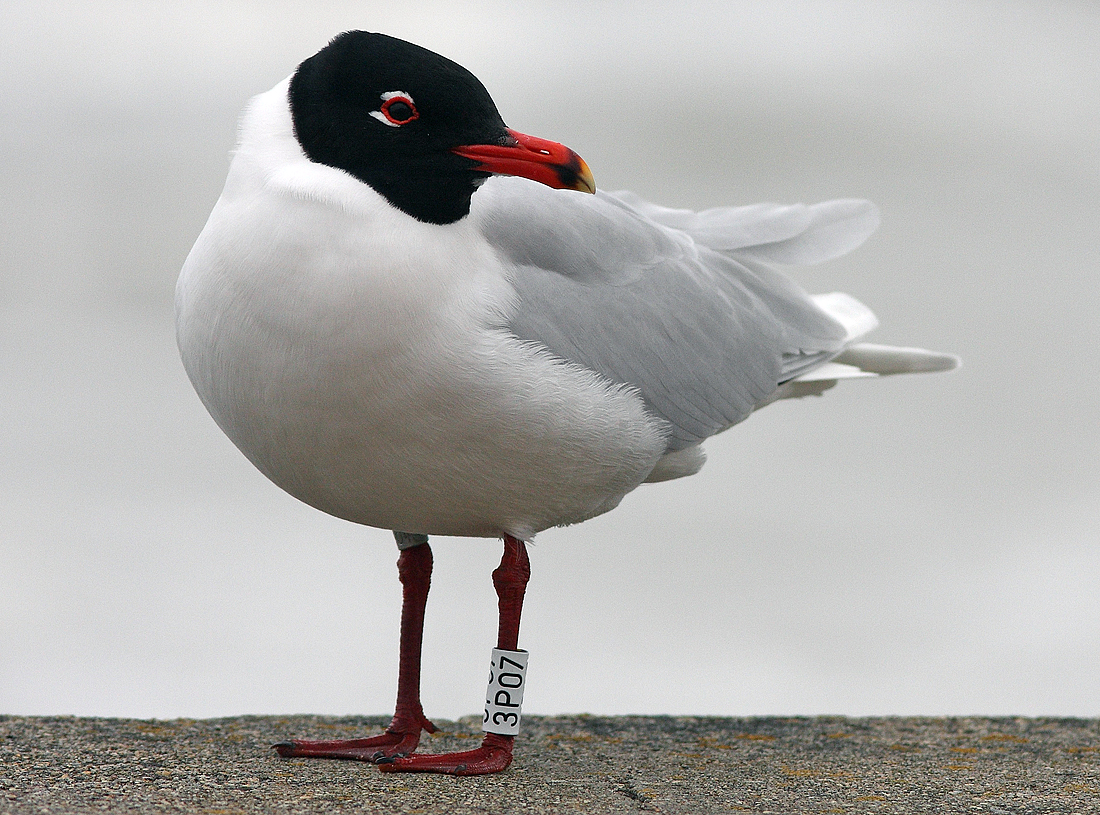
The next moult in Mediterranean Gull is again a partial moult, from December to March-April and includes body and head, leaving birds in so-called "adult summer" plumage. The head develops a jet-black hood, extending down the nape. Adult birds have broad and contrasting white crescents above and below the eye. The bare part coloration in adult plumage: Iris brown, orbital ring coral red, the bill scarlet red often with a thin black bill-band and a yellowish tip and the legs red.

Adult Mediterranean Gulls have established several new colonies on the northern borders of their distribution. They now breed regularly as far west as Britain and north to the Netherlands and Poland. Ring recoveries demonstrate that in spring adults may do a tour of Europe visiting colonies on the way and moving on quickly when the local breeding circumstances are not completely satisfactory. A nice example is white 24R, a bird ringed as adult on the nest in the Netherlands in May 1998. As so many Mediterranean Gulls, this individual has usually spent the period from late-summer to early spring at Le Portel. In between it has looked for breeding locations in the Netherlands, Belgium and Hungary. Despite intensive searches in the Zandvliet colony, it doesn't seem likely that 24R has ever bred here. In four consecutive years, this colony was visited early in the breeding season when it also functions as a roost, but there have been no records after late April. The sightings in Hungary in 1999, when it was definitely breeding, and at the end of the breeding season in 2007 are interesting. There are no sightings from the breeding season in other years but it seems that this bird has permanently switched to breeding in eastern Europe. This life-history also demonstrates how easily birds may travel within Europe. The sightings in July 2007 show that they navigate without difficulty to the main moult and feeding-location of Le Portel in NW France, where autumn groups always include some eastern Mediterranean Gulls from Italy, Poland, Hungary and even the Ukraine.

A summary of the records for White 24R/9AP with thanks to P.L. Meininger, R. Flamant and C. Duponcheel of the Mediterranean Gull colour-ring programme:

• ringed May 27 1998 to July 01 1998 at Hellgatsplaten, the Netherlands (3 records)
• from July 23 1998 to February 27 1999 at Le Portel, France (27 records)
• from April 03 1999 to April 14 1999 at Zandvlietsluis, Belgium (7 records)
• June 17 and 18 1999 at Mekszikópuszta, Hungary (2 records)
• from July 30 1999 to March 07 2000 at Le Portel, France (12 records)
• from April 08 to 12 2000 at Zandvlietsluis, Belgium (3 records)
• from July 25 2000 to March 10 2001 at Le Portel, France (26 records)
• from April 17 to 23 2001 at Zandvlietsluis, Belgium (5 records)
• from July 25 2001 to October 10 2001 at Le Portel (11 records)
• April 01 to 17 2002 at Zandvlietsluis, Belgium (4 records)
• from July 26 2002 to March 15 2003 at Le Portel (17 records)
• March 23 2003 at Berendrecht, Belgium (close to Zandvlietsluis), re-ringed 9AP
• from July 30 2003 to October 16 2003 at Le Portel, France (8 records)
• from February 10 2004 to February 27 2004 at Le Portel, France (4 records)
• from July 30 2004 to October 26 2004 at Le Portel, France (12 records)
• February 23 2005 at Le Portel, France
• from July 28 2005 to February 2 2006 at or near Le Portel, France (37 records)
• from July 27 2006 to November 3 2006 at Le Portel, France (19 records)
• July 10 2007 at Mekszikópuszta, Györ-Sopron, Hungary
• from July 19 2007 to February 19 2008 at Le Portel, France (15 records)

Biometry (measurements in mm’s) wing: 282-311, tail: 113-127, bill: 31-38, tarsus: 48-58; n = 21 (Dwight, 1925);


Impression of a mixed resting flock of Mediterranean Gulls, with Black-headed, Herring, Common, Great Black-backed, Lesser Black-backed and Yellow-legged Gulls in the evening of 06 February 2003, at the Rolo Parking of Boulogne/Mer, NW France.

Where do coloured ringed Mediterranean Gulls come from:


Sky Blue: (code 1 letter (R) and 2 numbers) Martin Boschert, Bühl - Germany, fax: +49-72.23-90.01.07., e-mail: bioplan.buehl@t-online.de, e-mail: christian-dronneau@cr-alsace.fr 
note 1: until 1999 some 145 rings have been placed from which 85 light-blue and 23 green.
note 2: the sky-blue is quick used and turns into 'white', therefore greens rings have been used since 1999. As first letter is used A,C,M, E,H,J and a second letter is used A,C,EH,J,K,L,M,N,P,R,T,V,W,X,Y. As number is used 1 till 9, but the number 0 is not used.

Dark Blue: white code (1 letter and 2 numbers) and recently (4 letters, the first is always I). Dark-blue rings 0AAA to 0CZZ. Instituto Nazionale per la Fauna Selvatica,

e-mail: nicola.baccetti@infs.it

note 1: in 2007 a new country code has been used: 0 (zero) instead of I, followed by 3 letters (on 0A... and 0B... the zero has a dot in the middle).

Dark-blue ring white code (5000 to 5018). Joan Ferrer Obiol, Apt. de correus 50, SP-43350 Les Borges del Camp, Tarragona, Spain. e-mail : jfo@tinet.org Albert Cama i Torrell.

e-mail : albert_km@hotmail.com

note 1 : birds were ringed during winter 2006 at Cambrils, Spain.

White ring code (2 numbers and 1 letter, 1 number and 2 letters since 1999). White ring with code (3-letter-number-number).

Camille Duponcheel, 10 La Maladerie, 59181 Steenwerck, France.

e-mail: cduponcheel@nordnet.fr with cc to Renaud Flamant Renaud.Flamant@skynet.be

note 1: after 14 years of encoding by Peter Meininger, the leader of this project, Camille Duponcheel has taken over.

note 2: ringed as pulli have the white ring on the left tarsus, adults on the right.

note 3: all sightings will be rewarded with a fully updated life history. Life histories of all birds ever sighted by one observer can be obtained (via e-mail only) through Renaud.Flamant@skynet.be

note 4 : from 2005 onwards, white rings with a 4 alphanumeric code are used in Belgium and The Netherlands. The code is a “3-letter-number-number” (e.g. 3A56). In 2005 some 400 colour-rings were used in Belgium and 100 rings in NL.

note 5 : during the summer 2006 in Denmark 20 birds have been ringed by Lars Hansen with a white ring coded cipher/letter/cipher/cipher.

Note 6 one white ring has been used in Poland, with black code T01N.

Yellow: (code 2 numbers / 1 letter)
Peter Findley, Kent - Britain, e-mail: pwjfindley@hotmail.com 
note 1: this project is running in the United Kingdom since 1996.
note 2: a few birds have been ringed in Ireland.
note 3: new codes used are 2A00-2A99 for Britain and 2E00-2E99 for Ireland.
Red ring with white code (letter (P) and two numbers) or number/letterP/number). Red ring with white code (letter (P) and letter (A) and letter/number (note 3) . Monika Czyzak, e-mail: monicz@stornit.gda.pl

note 1: used codes are P00-P99 new codes are 0P0-9P9.

note 2 : birds with ‘a-typical’ codes are T121, T081, T078, T1333.

Red ring with white code (3E1-5E0 ; S01-S99). Jan Svetlik, e-mail: jan.svetlik@nextra.sk

note 1: these rings have been used from 2001 onwards on chicks and breeding birds.

Red ring white code (81A-92A ; 7E1-7E9 ; 01E-50E). Josef Chytil,

e-mail: chytil@prerovmuzeum.cz

Red ring white code (letter (H) and 3 numbers) and (letter (H) and 3etter/letter/number (note 2). e-mail: ringers@mme.hu or karcza.zsolt@mme.hu

Red ring white code (4 or 3 alphanumeric code). Karcza Zsolt, Hungarian Bird Ringing Center, Költo 21, 1121 Budapest, Hungary. e-mail: ringers@mme.hu or karcza.zsolt@mme.hu

note 1: this project is running in Hungary since 1994, with some 500 rings in the period 1994-96 coded H101-H999.

note 2 : used letters are HU.., HY.., HA.., HL.., HF.., HT.. from 2004.

note 3: during the following years these codes could be used: 00L-99L, V00-V99, 0V0-9V9, 00V-99V, X00-X99, 0X0-9X9, 00X-99X and Y001-Y100 for Serbia-Montenegro.

note 4: some extra details on the red rings. H454-H470 : Serbia-Montenegro by Josef Gergely ; HA00-HA99 ringed from 1998 onwards ; 00A-99A from 1998 onwards with 81A-00A in the Czech Republic by Josef Chytil ; EOO-E99 from 1999 onwards : 0E0-9E9 from 1998 onwards with 3E1-5E0 in the Slovak Republic by Jan Svetlik and 7E1-9E0 in the Czech Republic by Josef Chytil ; 00E-9EE from 2001 onwards with 01E-50E in the Czech Republic by Josef Chytil ; K00-K99, 0K0-9K9, 00K-99K, L00-L99, 0L0-9L9 from 2002 onwards.

Black ring white code (letter U (horizontal) and 3 numbers vertical), or with white code (letter U-letter-number-number) or with white code (number-letter-number or number-number-letter or letter-number-letter). Renaud Flamant, 23 rue de l'Orme/Olmstraat, 1040 Brussels, Belgium. : e-mail: Renaud.Flamant@skynet.be

note 1: rings have been used in '94 and from '97 onwards (except '01).

note 2: in 1994 296 rings have been used in Ukraine (in collaboration with Antonina Rudenko & Tatjana Ardamatskaya).

note 3: from 1997 on, black rings have been used in Greece (in collaboration with Vassilis Goutner) and Turkey (in collaboration Suhendan Karauz).

note 4: from 1998 onwards, black rings have been used in Ukraine (in collaboration with Antonina Rudenko (Black Sea Biosphere Reserve), Valery Siokhin and Alexander Matsyura (Sivash).

note 5 : during summer 2006 in Greece 140 birds have been ringed by Vassilis Goutner ; code is 2 letters and 2 numbers.

Black ring 4 digit code, starting with O (with or without a ‘dot’). Instituto Nazionale per la Fauna Selvatica, e-mail: nicola.baccetti@infs.it

note 1 : since 2006 : 0AAA to 0ZZZ (only on the first 400 rings the zero has a dot in the middle: bad idea, everybody read it as 'B', so - from 0CAA on - the zero is a real zero).

Green ring white code (letter A, C or J, E, and P and 2 numbers) - used in France - Green ring with white code (letter R and 3 numbers or letter R and 2 numbers and 1 letter) - used in France - Green ring with white code (number/letter/number) - used in France - Green ring with white code (2 numbers and 1 letter (A,E,J,K,L,M,R,T,U,Y)) - used in Belgium - Green ring with white code (3-letter-letter-number) - used in Belgium . Camille Duponcheel, 10 La Maladerie, 59181 Steenwerck, France. e-mail: cduponcheel@nordnet.fr with a cc to Renaud Flamant when sent by e-mail Renaud.Flamant@skynet.be

For extensive notes on this project see www.cr-birding.be

note 1: the French and the Belgian projects are respectively running since 1991 and 2000. Around 850 and 750 green rings have been respectively used in France and Belgium until 2001.

note 2: all sightings will be rewarded with an up-to-date life history. Fully updated life histories of all birds ever reported by one observer can be obtained from Renaud Flamant (only via e-mail).

Green ring white code (AA + letter + letter).

Local responsible persons : Andreas Zours, Otterhaken 5, D-21107 Hamburg, Germany and Dr. Martin Schlorf, Geesmoor 31, D-22453 Hamburg. e-mail : medgullteam-hamburg@gmx.de AND bioplan.buehl@t-online.de

note 1 : for birds ringed in the Hamburg-area : AExx and AHxx where x means a letter out of A C E H J K L N R S T U Y Z.

Green ring white code (AC + letter + letter) or with white code (letter / number / letter). Dr. Martin Boschert, Bioplan - Institut für angewandte Biologie und Planung GbR, Nelkenstrasse 10, D - 77815 Bühl, Germany. e-mail : bioplan.buehl@t-online.de

note 1 : from 1999 till 2005 in Germany Med. Gulls were ringed at 5 places with a code (letter / number / letter) starting with A1A (in the Uppêr Rhine Valley) and M1A (near the river Elbe).


Small group of adult Mediterranean Gulls on the beach of Le Portel - NW France, preparing to leave this wintering quarter for the breeding grounds. Considering the green ringed bird in the front, these adults breed among others in Belgium and northern France. March 2003.

juvenile Mediterranean GullMediterranean Gull juvenile, July 28 2001, Le Portel, France.
juvenile Mediterranean GullMediterranean Gull juvenile H41, July 28 2001, Le Portel, France.
juvenile Mediterranean Gull (70832 bytes)Mediterranean Gull juvenile 3KR2, August 08 2003, Le Portel, France.
juvenile Mediterranean Gull (69625 bytes)Mediterranean Gull juvenile, August 08 2003, Le Portel, France.
juvenile Mediterranean Gull (76483 bytes)Mediterranean Gull juvenile A8M, August 08 2003, Le Portel, France.
juvenile Mediterranean Gull (89926 bytes)Mediterranean Gull juvenile, August 09 2003, Le Portel, France. 3 images.
juvenile Mediterranean Gull (69742 bytes)Mediterranean Gull juveniles, August 09 2003, Le Portel, France.
juvenile Mediterranean Gull (69742 bytes)Mediterranean Gull juvenile, August 03 2006, Le Portel, France.
juvenile Mediterranean Gull (113924 bytes)Mediterranean Gull juvenile P37, August 09 2003, Le Portel, France.
juvenile Mediterranean Gull (95969 bytes)Mediterranean Gull juvenile 3KN6, August 09 2003, Le Portel, France.
juvenile Mediterranean Gull (95969 bytes)Mediterranean Gull 1cy 3L62 & 3L81, September 17 2005, Le Portel, France.
2cy Mediterranean Gull green L37 (79181 bytes)Mediterranean Gull 2cy L37, January 03 2002, Boulogne-sur-Mer, France (50.42N,1.34E).
2cy Mediterranean Gull green 3JW2. (74368 bytes)Mediterranean Gulls 2cy 3JW2 & 14W, February 2003, Boulogne/Mer, France (50.42N,1.34E).
2cy Mediterranean Gull green 3LM2. (67121 bytes)Mediterranean Gull 2cy 3LM2, February 06 2003, Boulogne/Mer, France (50.42N,1.34E).
2cy Mediterranean Gull green 3LU4, in February. (70265 bytes)Mediterranean Gull 2cy 3LU4, February 07 2003, Boulogne-sur-Mer, France (50.42N,1.34E).
2cy Mediterranean Gull (52022 bytes)Mediterranean Gull 2cy K49, April 20 2002, Boulogne-sur-Mer, France (50.42N,1.34E).
complete moult in 2cy Mediterranean GullMediterranean Gull 2cy, July 27 2001, Le Portel, France (50.42N,1.34E).
complete moult in 2cy Mediterranean Gull. (90579 bytes)Mediterranean Gull 2cy 63P, August 09 2003, Le Portel, France.
complete moult in 2cy Mediterranean Gull. (55400 bytes)Mediterranean Gull 2cy 48W, August 09 2003, Le Portel, France.
complete moult in 2cy Mediterranean Gull. (87871 bytes)Mediterranean Gull 2cy, August 09 2003, Le Portel, France.
complete moult in 2cy Mediterranean Gull. (79340 bytes)Mediterranean Gull 2cy 3JE7, August 09 2003, Le Portel, France.
complete moult in 2cy Mediterranean Gull. (81374 bytes)Mediterranean Gull 2cy, August 09 2003, Le Portel, France.
complete moult in 2cy Mediterranean Gull. (74951 bytes)Mediterranean Gull 2cy 3NW5, August 09 2003, Le Portel, France.
3cy Mediterranean Gull Budapest 368817 (89915 bytes)Mediterranean Gull 3cy 368817, January 03 2002, Boulogne-sur-Mer, France (50.42N,1.34E).
3cy Mediterranean Gull (72060 bytes)Mediterranean Gull 3cy, January 03 2002, Boulogne-sur-Mer, France (50.42N,1.34E).
3cy Mediterranean Gull ringed green L33, in February. (57051 bytes)Mediterranean Gull 3cy L33, February 06 2003, Boulogne-sur-Mer, France (50.42N,1.34E).
3cy Mediterranean Gull in February. (64142 bytes)Mediterranean Gull 3cy, February 06 2003, Boulogne-sur-Mer, France (50.42N,1.34E).
3cy Mediterranean Gull in February. (62591 bytes)Mediterranean Gull 3cy, February 06 2003, Boulogne-sur-Mer, France (50.42N,1.34E).
3cy Mediterranean Gull ringed green 3CA9, in February. (64949 bytes)Mediterranean Gull 3cy 3CA9, February 07 2003, Boulogne-sur-Mer, France (50.42N,1.34E).
3cy Mediterranean Gull ringed green K57 in February. (67794 bytes)Mediterranean Gull 3cy K57, February 07 2003, Boulogne-sur-Mer, France (50.42N,1.34E).
3cy Mediterranean Gull in February. (50170 bytes)Mediterranean Gull 3cy, February 07 2003, Boulogne-sur-Mer, France (50.42N,1.34E).
3cy Mediterranean Gull in March. (69630 bytes)Mediterranean Gull 3cy, March 17 2003, Boulogne/Mer, France (50.42N,1.34E).
3cy Mediterranean Gull white 4HSMediterranean Gull 3cy 4HS, July 28 2001, Le Portel, France (50.42N,01,34E).
3cy Mediterranean Gull white 3FZMediterranean Gull 3cy 3FZ, July 30 2001, Le Portel, France (50.42N,01,34E).
3cy Mediterranean Gull in August, green E52. (91304 bytes)Mediterranean Gull 3cy E52, August 09 2003, Le Portel, France.
adult Mediterranean Gull in August. (89219 bytes)Mediterranean Gull 46M 3cy, August 10 2004, Le Portel, France.
adult Mediterranean Gull in August. (67334 bytes)Mediterranean Gull H07 3cy, August 10 2004, Le Portel, France.
adult or 3cy Mediterranean Gull (61463 bytes)Mediterranean Gull 3cy or adult, September 20 2002, Boulogne/Mer, France (50.42N,1.34E).
adult Mediterranean Gull ringed PARIS (79052 bytes)Mediterranean Gull adult Paris ?24398?, January 03 2002, Boulogne-sur-Mer, France (50.42N,1.34E).
adult Mediterranean Gull ringed PRAHAMediterranean Gull adult Praha ?E.15800, January 03 2002, Boulogne-sur-Mer, France (50.42N,1.34E).
adult Mediterranean Gull white E99V (75923 bytes)Mediterranean Gull adult E 99V, January 03 2002, Boulogne-sur-Mer, France (50.42N,1.34E).
adult Mediterranean Gull white 39V (66005 bytes)Mediterranean Gull adult 39V, January 03 2002, Boulogne-sur-Mer, France (50.42N,1.34E).
adult Mediterranean Gull white 6AY, in February. (65009 bytes)Mediterranean Gull adult 6AY, February 06 2003, Boulogne-sur-Mer, France (50.42N,1.34E).
adult Mediterranean Gull white 2AY, in February. (67860 bytes)Mediterranean Gull 5cy 2AY, February 06 2003, Boulogne-sur-Mer, France (50.42N,1.34E).
adult Mediterranean Gull green 219, in February. (63513 bytes)Mediterranean Gull adult 219, February 06 2003, Boulogne-sur-Mer, France (50.42N,1.34E).
adult Mediterranean Gull white 8AT, in February. (67595 bytes)Mediterranean Gull adult 8AT, February 06 2003, Boulogne-sur-Mer, France (50.42N,1.34E).
adult Mediterranean Gull green 3CW3, in February. (60730 bytes)Mediterranean Gull adult 3CW3, February 06 2003, Boulogne-sur-Mer, France (50.42N,1.34E).
adult Mediterranean Gull green K51, in February. (67556 bytes)Mediterranean Gull adult K51, February 06 2003, Boulogne-sur-Mer, France (50.42N,1.34E).
adult Mediterranean Gull green K88, in February. (54473 bytes)Mediterranean Gull adult K88, February 07 2003, Boulogne-sur-Mer, France (50.42N,1.34E).
adult Mediterranean Gull green K42, in February. (58911 bytes)Mediterranean Gull adult K42 & 3JP5, February 07 2003, Boulogne-sur-Mer, France (50.42N,1.34E).
adult Mediterranean Gull green 17M, in February. (61326 bytes)Mediterranean Gull adult 17M, February 07 2003, Boulogne-sur-Mer, France (50.42N,1.34E). Group of adult.
adult Mediterranean Gull red 963 T, in February. (73560 bytes)Mediterranean Gull adult 963, February 07 2003, Boulogne-sur-Mer, France (50.42N,1.34E). 
adult Mediterranean Gull in March. (63819 bytes)Mediterranean Gull adult, March 16 2003, Boulogne/Mer, France (50.42N,1.34E). 
adult Mediterranean Gull in March. (56421 bytes)Mediterranean Gull adult, March 17 2003, Boulogne/Mer, France (50.42N,1.34E). 
adult Mediterranean Gull in March. (57581 bytes)Mediterranean Gull adult, March 18 2003, Boulogne/Mer, France (50.42N,1.34E). 
adult Mediterranean Gull ringed green 78UMediterranean Gull adult 78U, & R246, July 28-30 2001, Le Portel, France.
3 adult Mediterranean Gulls, including red ringed 731Mediterranean Gull 731, July 30 2001, Le Portel, France.
adult Mediterranean Gull in August. (85548 bytes)Mediterranean Gull 2A09, August 09 2004, Le Portel, France.
adult Mediterranean Gull in August. (66461 bytes)Mediterranean Gull 41N, August 09 2004, Le Portel, France.
adult Mediterranean Gull in August. (95830 bytes)Mediterranean Gull 60Z, August 10 2004, Le Portel, France.
adult Mediterranean Gull in August. (66374 bytes)Mediterranean Gull 8AJ, August 10 2004, Le Portel, France.
adult Mediterranean Gull in August. (69387 bytes)Mediterranean Gull 50A, August 10 2004, Le Portel, France.
adult Mediterranean Gull in August. (83150 bytes)Mediterranean Gull 4HV, August 10 2004, Le Portel, France.
adult Mediterranean Gull (49170 bytes)Mediterranean Gull adult, October 24 2002, Boulogne-sur-Mer, France (50.42N,1.34E).